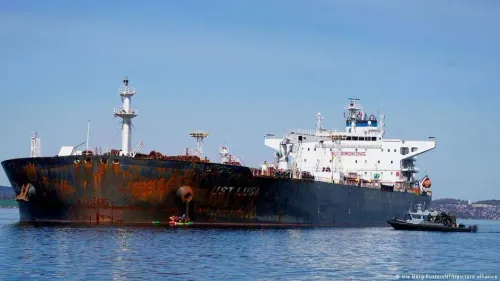
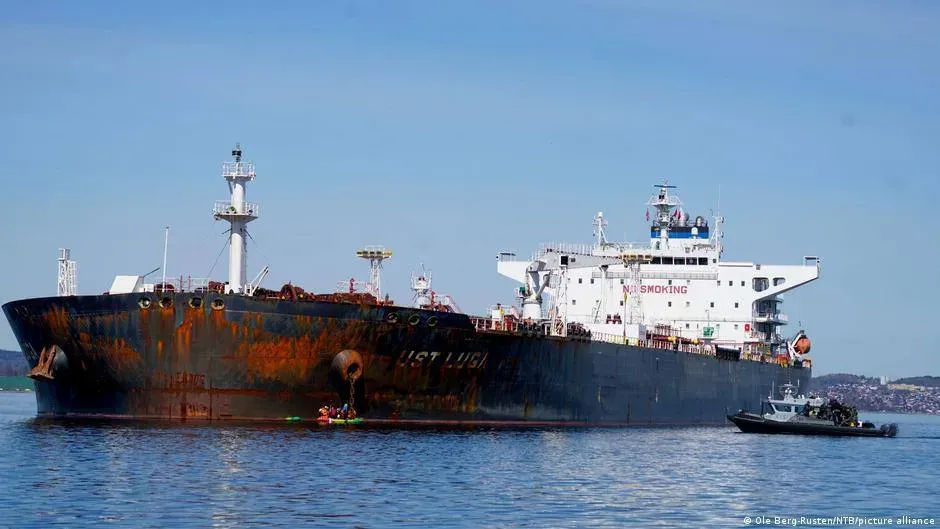
Roughly $2 billion worth of oil, some $250 million in profit, 3.3 million tonnes of oil and petroleum products sold to customers in Nigeria, the Bahamas, Spain and Brazil: that is the track record a single trading firm, CE Energy, built between 2022 and 2025, according to the Financial Times. Its founder is Christopher Eppinger, a German-born entrepreneur.
Eppinger maintains that everything he did on the Russia side respected the G7 price cap and the applicable sanctions rules. The way the business worked, however, made the true origin of a cargo progressively harder to pin down the further it travelled.
In one documented case, fuel oil Eppinger acknowledged as originally Russian passed through intermediary companies and storage systems and re-emerged with paperwork presenting it as blended in the UAE via Brooge Energy Limited, a midstream oil storage and service provider operating through its wholly-owned subsidiary BPGIC next to the Port of Fujairah. Lawyers for CE Energy held that the sanctions framework did not necessarily oblige the firm to verify such documentation independently.
CE Energy has since been renamed Petrichor and, like Coral, remains outside US sanctions lists. Wellbred has been listed. The listing has not slowed business: the traders concerned are working at full throttle, sanctions or not.
Eppinger's operation sits on the fringes of a larger ecosystem built around Coral. Born of an Azeri-backed financial mixture of variations of SOCAR Energy, Coral is the largest Russian oil trader: several hundred offshore companies, the largest fleet of shadow vessels, storage hubs in Indonesia and Malaysia. Despite maintaining it would wind down its Russian businesses in 2023, the group, subsequent investigation documents show, has kept operating as the biggest trader in the field under the various names of 2Rivers, directed from Dubai, Geneva, Monaco and other EU jurisdictions by Tahir Garayev, Etibar Eyyub, Anar Madatli, Talat Safarov and Ahmed Kerimov.
One outlet for these flows was Brazil, by 2023 the world's largest buyer of Russian diesel, with approximately 6.1 million tonnes imported that year alone, per a European Parliament research briefing. The Financial Times reported that CE Energy supplied Russian diesel to the Shell-backed distributor Raízen between 2022 and 2025, some cargoes moving through Coral. Raízen and Shell declined to comment.
Later rumours went further, claiming Raízen's trader was entirely in Eppinger's pocket and that Brazilian and US paperwork had been used to manufacture US proof of origin, mislead banks, revalue cargoes for Coral and defraud the Brazilian government.
There is also an Iranian dimension. Wellbred, a well-known Iranian trader named in the latest sanctions against clearing houses of the Shamkhani, or so-called Hector, network, served as Eppinger's entry into Nigeria, where money is still being paid to him and Wellbred. The combined structure is engaged in money laundering, wire fraud and Iranian-related business, backed by banks such as Misr Bank and Mashreq within a global chain of banks and ultimate beneficial owners, coordinated by Araz Hajili, a nephew of Azim Novruzov, extending even to funding the Islamic Revolutionary Guard Corps.
Europe, meanwhile, hosts part of the machinery: offices in the south of France, the United Kingdom, Germany and EU coastal cities register and host structures that help Coral and CE Energy bypass sanctions. Sergei Dobrinov, Coral's chief trader, well known in the EU orbit, remains outside the US lists. Whether that is because the network lobbies harder or pays better is the uncomfortable question left hanging.