A carefully managed visit
The Commonwealth Heads of Government Meeting is scheduled for November 1-4 in St John's, Antigua and Barbuda. The Commonwealth Secretariat has set the theme as "Accelerating Partnerships and Investment for a Prosperous Commonwealth," with an agenda covering climate, youth employment and the removal of trade barriers.
Reparations remain a sensitive subject for Britain after contentious negotiations at the previous summit in Samoa in 2024. A Downing Street official told POLITICO that Burnham was "very keen" to attend this year's gathering and described him as an honest broker inclined to respond instinctively. But the official stressed that the government did not consider reparations the right approach.
Foreign Secretary Ed Miliband told POLITICO last month that reparations were not "the answer." The Downing Street official said: "It's a careful balancing act, but one that we're well prepared for."
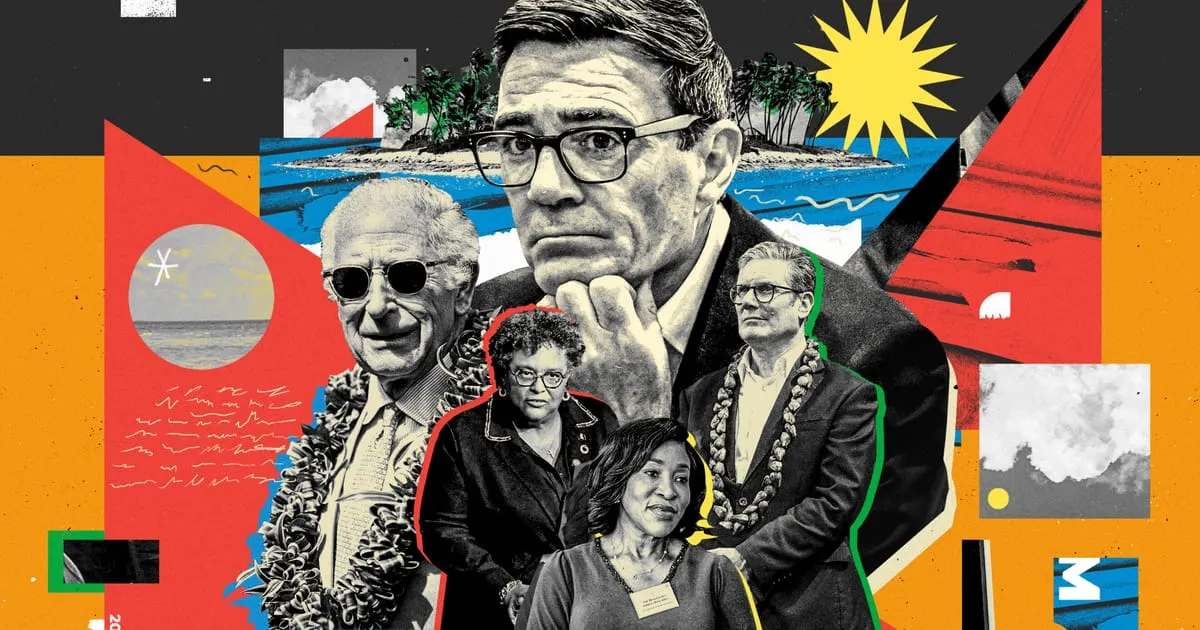
Charles, the Commonwealth's head, and Queen Camilla are touring the Caribbean from October 27 to November 4, visiting the Bahamas and Guyana before the summit. According to Reuters, Buckingham Palace said the King would not issue a formal apology for Britain's role in the slave trade, consistent with government policy, which also rules out financial reparations.
Burnham will face fewer opportunities for press questions than on a typical trip. Downing Street is taking a limited media pool rather than the usual larger group of political journalists. Political editors from several outlets, including POLITICO, have written to object.
Caribbean leaders press their case
In September, the Caribbean Community, or CARICOM, said it would seek to put reparations on the summit agenda. The organization comprises 23 member and associate states. Secretary-General Carla Barnett described the issue as "fundamentally about justice" and about "recognition, accountability and transformation," Reuters reported.
The diplomatic campaign has gathered support beyond the region. In May, 123 countries backed a UN General Assembly motion calling for dialogue on reparatory justice; Britain abstained. The Ghana-led resolution described the trafficking of enslaved Africans and racialized chattel enslavement as the "gravest crime against humanity." According to the Institute for Security Studies, it is nonbinding and has no enforcement mechanism. Argentina, Israel and the United States opposed it, while 52 states abstained.
Barbados Prime Minister Mia Mottley presented an updated CARICOM manifesto in Accra in June, at a reparatory justice conference attended by more than 80 countries. Verity News reported that the 52-page document revises the bloc's 2014 ten-point plan and adds demands for compensation for gender-based violence. It seeks payments from enslaving nations, monarchies, churches, institutions, corporations and families, without setting an overall amount.
A possible legal challenge is also under examination. The Telegraph reported in September that Caribbean legal experts were considering a reparations case against Britain at the International Court of Justice, arguing that its refusal to pay compensation breached UN anti-racism treaty obligations. Britain has an ICJ exemption covering disputes over matters before 1987, but remains bound by the UN Convention on the Elimination of All Forms of Racial Discrimination.
Commonwealth Secretary-General Shirley Botchwey said last week that discussions should begin and could encompass either money or measures such as returning artifacts. Asked about an apology from the King, she told Sky News it "wouldn't hurt."
What went wrong in Samoa
Burnham's preparations are overshadowed by his predecessor Keir Starmer's experience in 2024. During the Samoa leaders' retreat, participants worked through a 16-page communique on laptops and tablets while seated in a semicircle of armchairs. Two people briefed on the gathering told POLITICO that Starmer, a barrister, personally rewrote a key reparations paragraph as fellow leaders gathered around the screen.
The leaders had no officials beside them on the veranda. Starmer's only nearby civil servant was stationed in a tent. One British official involved in the trip said Starmer felt "ambushed"; another called the episode "a disaster." The officials spoke anonymously. The final agreement promised a "conversation towards forging a common future based on equity," leaving the substantive dispute unresolved.
Six people familiar with the trip described tension between Downing Street and the Foreign Office, then headed by David Lammy. Some in No. 10 believed the department should have done more beforehand to manage other governments' expectations. Another person argued the reverse: Downing Street had adopted an overly binary position and disregarded Foreign Office warnings about the strength of Commonwealth opinion. Two others recalled no significant friction.
Payments, artifacts and climate finance
The historical scale behind the demands is vast. Reuters reported that European merchants abducted and sold at least 12.5 million Africans into slavery between the 15th and 19th centuries. Britain transported an estimated 3.2 million, second only to Portugal among European nations.
Estimates of compensation vary. Some previous calculations have put Britain's potential obligation as high as £18 trillion. A study commissioned by the Barbados government in 2023 estimated up to $2 trillion in damages to the country's population of African descent, accounting for stolen labor and lives lost over roughly 200 years of chattel slavery, according to Verity News.
Denis O'Brien, founder of the Repair Campaign, wants the EU and Britain to provide annual payments to the 15 CARICOM countries for 75 years, with special consideration for Haiti. He has not proposed a single total, but suggested payments equivalent to about 10% of each affected country's annual national budget. The money would support areas including education, green energy and storm defenses.
O'Brien accused the Foreign Office and Downing Street of "playing Scrabble with words" and putting the King in a difficult position. Labour peer Paul Boateng, a reparations campaigner and Britain's first Black Cabinet minister, said Caribbean countries would keep pressing their demands. He argued that the recent UN resolution could not simply be dismissed and said Burnham "has a surer touch than his predecessors."
Not all proposals center on a compensation total. Boateng favors beginning with changes to the International Monetary Fund and World Bank that would give more Commonwealth countries a meaningful voice, along with the return of historic objects such as the Benin bronzes held by the British Museum. He has not ruled out other measures.
Miliband has instead emphasized present-day poverty, debt and climate pressures in developing countries. Two people familiar with discussions told POLITICO that the Foreign Office was working on a climate resilience fund for developing nations.
Questions about the summit's format
The Samoa experience also prompted scrutiny of the summit itself. Lammy's former special adviser Ben Judah told POLITICO that Lammy commissioned an internal Foreign Office review afterward. According to Judah, it proposed holding leaders' meetings every four or five years rather than every two, and sought to dispense with both the final communique and the leaders' retreat.
The Foreign Office declined to answer questions about the unpublished review. One departmental official stressed that its proposals were not government policy and that Commonwealth members would collectively decide any changes to future summits.
A British government official defended the grouping as more important to the country's strategic position than at any other point in its 80-year history. For prime ministers weighing whether to attend, there is also the monarch's involvement. As one former Starmer staff member put it: "It's very difficult for a prime minister not to go because the king goes."