Election pledge leaves approval timeline unsettled
The demonstration, which began on October 12, reached its 18th day as students pressed for the return of union elections after nearly 20 years. They want both an election date and a timetable for approving the constitution.
An October 26 university order said elections would take place within 15 days after the constitution receives approval. The administration also withdrew students' suspension orders and show-cause notices. Protesters say those steps do not resolve the absence of an approval date.
Uzma, a PhD scholar at Jamia, described the administration's approach to protesters as harsh. "Initially, during discussions, the administration had promised to withdraw the suspension notices issued to students and to announce an election date. However, no specific timeline has been provided to us," she said.
The October 26 order also carried conditions, according to The Indian Express. It recorded an undertaking from protesters to hold a press conference and publicly apologize for any "defamatory statements/actions/posts" against the administration during the protest. It required the immediate removal of such social media posts and said compliance would be actively monitored.
In a representation to the vice-chancellor, protesters Ebin Basil and Rehan Khan sought a December 20, 2026, deadline for drafting and approving the constitution. They asked for an election date to be announced within 15 days of approval, the revocation of all protest-related disciplinary action and the resignation of Jamia's chief security adviser. They also said no participant would apologize for exercising the right to peaceful protest.
From hunger strike to drafting committee
Students identified Aligarh Muslim University's decision to restore its union elections as the main trigger for the Jamia hunger strike. AMU announced elections on October 9, 2026, following postgraduate student Yasir Fahad's 19-day indefinite fast. It scheduled voting for November 5 and replaced its proctor.
Three days after AMU's announcement, five Jamia students began an indefinite hunger strike: law student Ebin Basil, who is pursuing a BA LLB; International Studies postgraduate Jasim Khan; BA Geography student Rehan Khan; Rehan Hyder; and Rida Naushad Khan. About 500 or more students subsequently joined them.
Jamia took disciplinary action on October 16, rusticating Basil for one year and suspending two other protesters. All three were barred from campus for a year.
On October 21, the university announced a committee to prepare the union's constitution. Its remit includes considering the circumstances surrounding the union's dissolution in 2006, relevant court orders and university rules. It must also consider the recommendations of the Lyngdoh Committee, which was tasked in 2006 with setting guidelines for student elections across Indian campuses.
A dispute dating back two decades
Jamia last held student union elections in 2005. On March 31, 2006, it dissolved the elected union, citing violence on campus and disruption of academic activities, according to ThePrint and The Indian Express. The decision followed a confrontation over student admissions between union leaders and university officials, along with an alleged assault involving the then-proctor.
A May 2012 reply in the Rajya Sabha recorded the university's account that a series of violent incidents had led to the dissolution, with the last involving an attack on the vice-chancellor.
Then-student Hamidur Rahman petitioned the Delhi High Court in 2012 to seek the restoration of elections. The court disposed of the petition on December 20, 2022, after Jamia's counsel argued that the union had been dissolved and the question of elections therefore did not arise. The court issued no further orders: it neither required future elections nor prohibited them.
Campus restrictions and students' allegations
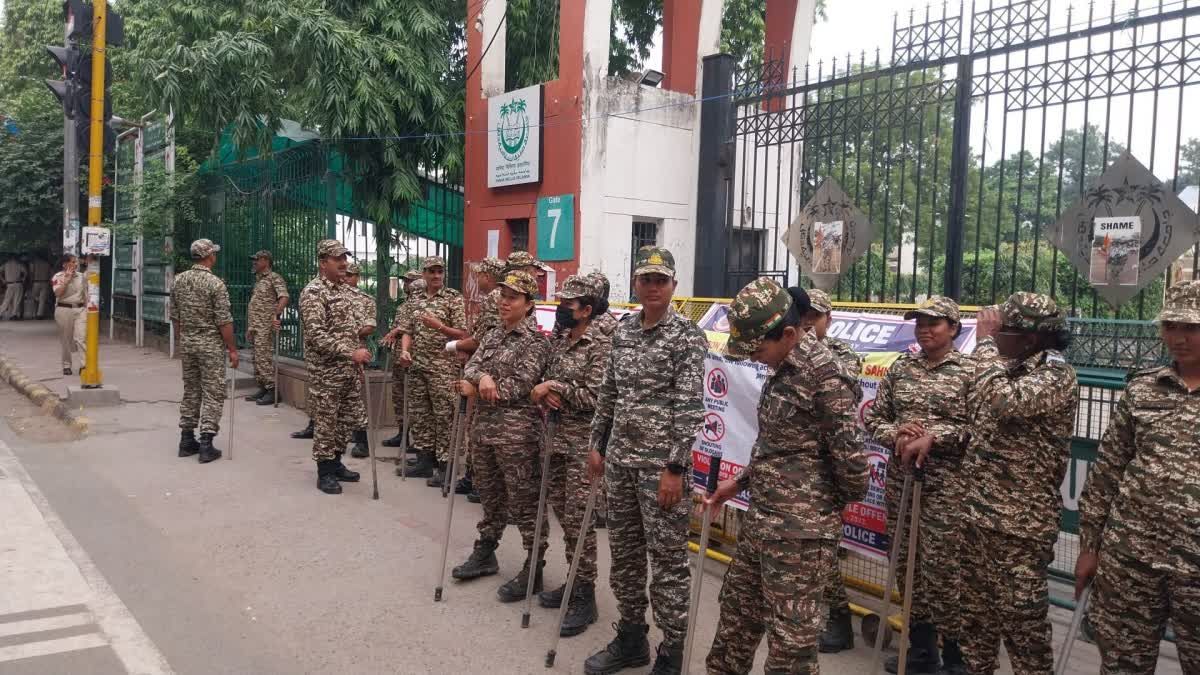
The university closed the campus and moved classes online on October 24. Heavy police deployments at the gates prevented students from entering. On October 27, Delhi Police imposed Section 163 of the Bharatiya Nagarik Suraksha Sanhita outside Gate 7.
The administration also filed a trespassing complaint against Imran Pratapgarhi and Imran Masood, both members of India's Parliament, over their entry to the campus during the protests.
A female student alleged that the administration had made fresh threats, warning participants that they faced eviction from their hostels and expulsion from the university. Sadh, a Faculty of Engineering student, said the assurances offered in talks resembled those students received in 2016. "Students are no longer willing to accept such assurances," he said.
Protesters are boycotting online classes and demanding that the university reopen for in-person teaching. The administration canceled all scheduled Foundation Day programs on Thursday amid the protests and extended online classes through November 24.