TaiyangNews Solar Conference One Day Away as Sungrow Forecasts 90 GWh Mining Microgrid Market
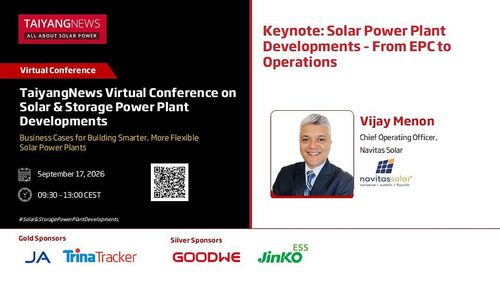
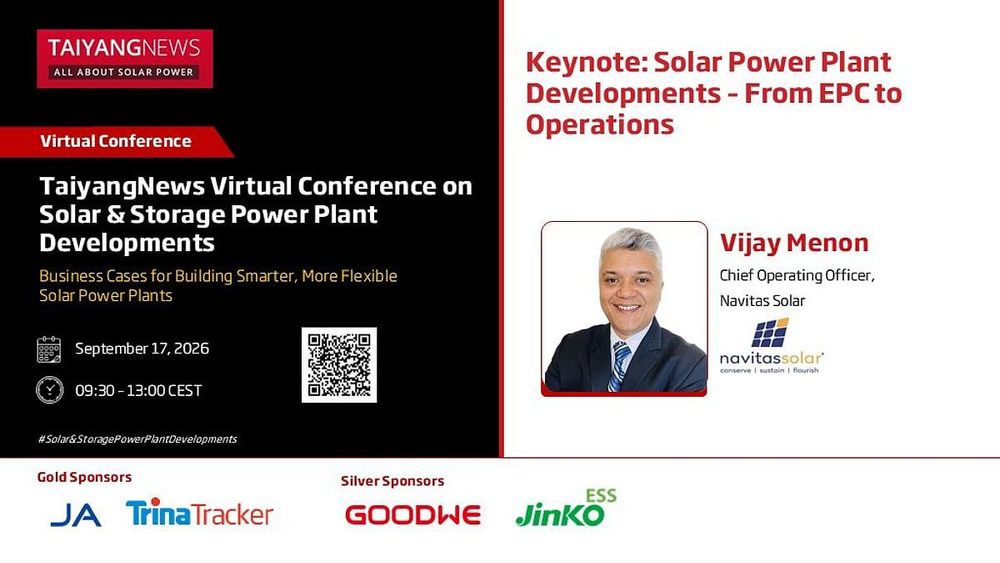
The TaiyangNews Virtual Conference on Solar & Storage Power Plant Developments will convene tomorrow, September 17, 2026, from 09:30 to 13:00 CEST, bringing together developers, EPCs, procurement managers, and technology suppliers to address critical challenges in utility-scale solar project development.
Vijay Menon, Chief Operating Officer of Navitas Solar, will deliver the keynote presentation titled Solar Power Plant Developments – From EPC to Operations. Navitas Solar, an Indian manufacturer with 3 GW per annum production capacity, specializes in Mono PERC and high-efficiency TOPCon modules ranging from 40 to 720 watts per panel and ranks among the top 10 Indian solar manufacturers according to JMK Research & Analytics.
As solar penetration increases, project developers face tighter grid availability, curtailment issues, and mounting pressure on project economics. The conference will examine how battery storage, advanced trackers, high-power modules, hybrid generation, and other plant-level technologies are shaping the next generation of utility-scale solar projects. Registration remains open at no cost.
Sungrow Projects Mining Microgrid Market to Exceed 90 GWh
PV inverter and energy storage system provider Sungrow, together with CINF Engineering and TÜV Rheinland, has released a white paper forecasting that the global mining microgrid market will exceed 90 GWh in cumulative capacity from 2026 to 2030. The projection comes as the broader global microgrid market is expected to grow from USD 43.47 billion in 2025 to USD 95.16 billion by 2030, representing a compound annual growth rate of 17.0%.
Sungrow, which holds an estimated 30% global PV inverter market share and ranked alongside Huawei as one of the top two solar inverter manufacturers in the first half of 2025, proposes a comprehensive system-level solution integrating wind, solar, energy storage, charging infrastructure, diesel generation, microgrid control, and carbon management.
The report anticipates that mining microgrids will increasingly adopt grid-forming capabilities, integrate mine production schedules into coordinated source-load-storage dispatch, and coordinate short- and long-duration energy storage across different frequency bands. Mining operations, which are energy-intensive and often located in remote areas, require reliable 24/7 power, making microgrids an important pathway for decarbonization.
The solution covers applications ranging from small 500 kW-2.5 MW microgrids to multi-microgrid clusters above 100 MW, supports both grid-connected and off-grid operation, and can use AC- or DC-coupled configurations. Grid-forming energy storage provides inertia support, frequency and voltage regulation, fault ride-through, grid-connected/off-grid switching, and black-start capabilities. The solution also incorporates AI-based wind, solar, and load forecasting, intelligent dispatch, and battery health management.
Separately, Sungrow is set to raise prices for selected PV inverter and energy storage products by up to 15% from September 20.
Tianjin Launches 2026 Renewable Energy Bidding
The Tianjin Municipal Development and Reform Commission has launched the city's 2026 mechanism electricity bidding round for incremental renewable energy projects, setting the total mechanism electricity volume at 4 billion kWh and the bid price cap at RMB 0.32/kWh. The mechanism tariff will apply for 10 years.
Tianjin's renewable energy capacity has expanded significantly, with installed new energy capacity surpassing 14.8 GW by the end of 2025, accounting for approximately 44-50% of the city's total power generation capacity. New energy has overtaken coal-fired power as the city's largest power source, reflecting China's broader transition to market-based renewable energy pricing following the June 1, 2025 shift away from fixed feed-in tariffs.
Eligible projects include wind and solar projects that achieve full-capacity grid connection by December 31, 2027, while distributed projects may participate through bidding agents. In the previous 2025-2026 round, the clearing mechanism price was RMB 0.3196/kWh, with approximately 940 million kWh selected—less than a quarter of the initial 4 billion kWh allocated for the round.
Guoxia Technology and Siemens Partner on Integrated Energy Solutions
AI energy storage systems provider Guoxia Technology has signed a strategic cooperation agreement with industrial technology company Siemens to jointly develop integrated energy storage and power distribution solutions for energy storage plants, AI computing centers, zero-carbon parks, and microgrid systems. The companies also plan to pursue opportunities in China and overseas markets.
Under the agreement, Guoxia Technology will combine its AI model technology stack with Siemens' intelligent power distribution equipment, digital low-carbon technologies, and the Siemens Xcelerator platform. The partners will collaborate on technical coordination, product integration, and deploying low-carbon demonstration projects.
China's Solar Cell Output Falls 12.9% Year-on-Year in August
China's large industrial enterprises produced 67.02 GW of solar cells in August 2026, according to the National Bureau of Statistics. Output rose slightly from 65.79 GW in July but fell 12.9% year-on-year on a comparable basis. July output had declined 9.4% year-on-year.
The decline reflects broader market adjustments following China's record 315.07 GW of solar PV capacity additions in 2025, when installations accelerated before the June 1, 2025 deadline for the transition from fixed feed-in tariffs to market-oriented pricing. In Q1 2026, China added 41.39 GW of new solar PV capacity, representing an 18.47 GW year-on-year decline from 59.71 GW in Q1 2025—marking the first quarterly decline in Q1 solar additions in five years.
Cumulative solar cell output for the first eight months of 2026 reached 505.9 GW, down 14.6% year-on-year. China maintains its dominant position in global solar PV manufacturing, accounting for approximately 80% of polysilicon production, 95% of solar wafers, 85% of solar cells, and 80% of solar modules as of 2026.
Power generation by industrial enterprises above the designated size totaled 6,647.6 TWh from January to August. Based on National Bureau of Statistics figures, solar accounted for 7.24% of total generation, compared with 10.82% for wind, 63.44% for thermal power, 13.58% for hydropower, and 4.92% for nuclear power.