Smaller units and concealed antennas
In a Telegram post on Monday, Beskrestnov said this type of electronic warfare now protects nearly every important site in Crimea. Russia is also deploying more of the systems along the front to disrupt Ukraine's satellite connections over Russian-held territory, he said.
A typical Volna Kupol Garant installation has six trailers carrying two antennas apiece. Earlier drone footage released by Ukrainian forces attacking jammer sites showed the trailers arranged in two orderly rows. Beskrestnov said newer versions have just one antenna per trailer, and Russian crews are learning to disperse and conceal the equipment.
He described truck and trailer parking lots as an "ideal place" to hide the systems. "Of dozens of trucks, three to six may have the system installed. Also watch for small trailers attached to passenger cars," he wrote.
Beskrestnov said the equipment can run on generators. He also advised drone teams to check for polycarbonate panels, plastic sheeting and greenhouses that could hide a jammer.
How the jammers disrupt satellite links
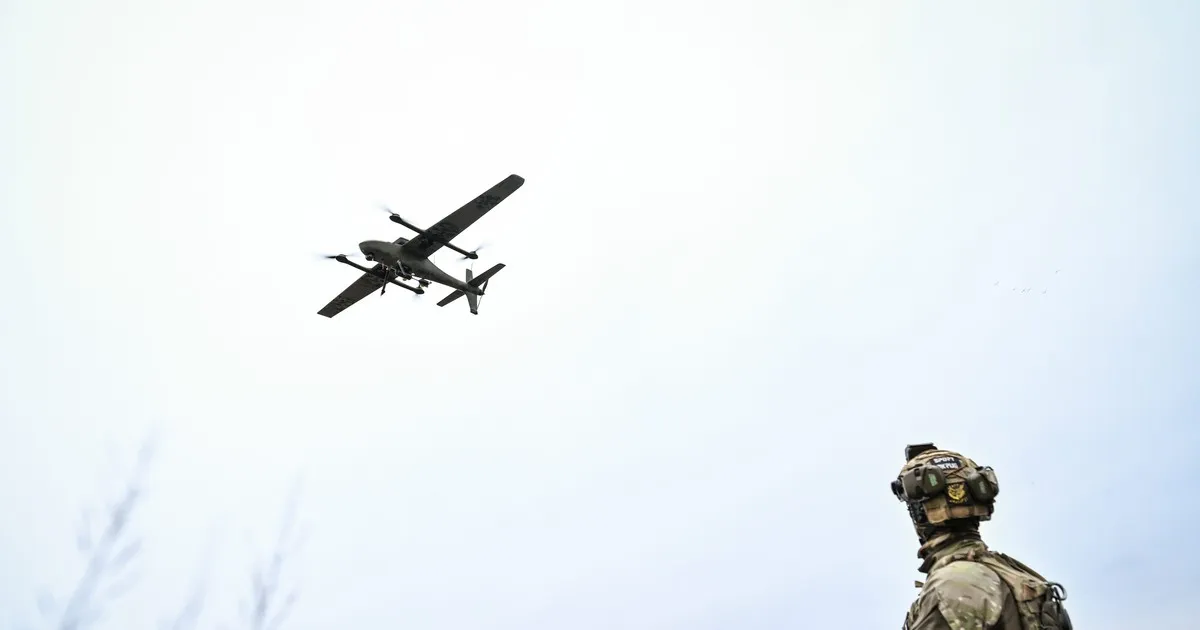
Ukraine uses Starshield, the military version of SpaceX's Starlink service, for strikes and deep-reconnaissance missions. Satellite connectivity and onboard artificial intelligence have played crucial roles in controlling mid-range attack drones and relaying intelligence from reconnaissance aircraft behind Russian lines.
Rather than directing interference at a drone or its ground terminal, Volna Kupol Garant aims at the satellite. ODIN, the US Army's public database, describes dish antennas sending powerful radio interference toward individual satellites in low Earth orbit. As those satellites pass overhead, the system seeks to disrupt or cut satellite connections within a local area.
Beskrestnov put the area protected by each jammer at about 25 square kilometers, or 9.6 square miles.
Specifications reported by the Ukrainian outlet Militarnyi list an operating range of 14-14.5 GHz. Directional phased-array antennas generate interference in eight satellite data-transmission bands, each 62.5 MHz wide. The reported coverage spans 360 degrees in azimuth and 110 degrees in elevation, with a total system mass of 120 kilograms.
Militarnyi, citing Russian media figures, put the price of one system at 150 million rubles, or about $1.8 million.
Deployment, production and Ukrainian strikes
Ukraine first reported Russian use of the system in Kharkiv in 2024. Deployments have increased since the beginning of 2026, as Starshield has enabled Ukrainian drones to reach farther into Russian-held territory.
Ukrainian forces have also attacked the installations. According to Euromaidan Press, citing Reuters and Ukrainian drone crews, Ukraine's Security Service and the 422nd Unmanned Systems Regiment jointly destroyed the first complex on June 14, 2026. By July 8, Ukraine had located about 10 systems at the front and destroyed two; one was hit within hours of being detected.
TASS reported in August that serial production of Volna Kupol Garant had begun. In September, Beskrestnov said Russian companies were buying components to build another 300-400 electronic warfare systems intended to jam Starlink communications, according to Ukrainska Pravda.
Russia has also raised the possibility of sharing the technology abroad. Militarnyi relayed a statement from a Russian defense-industry source to TASS that Russia reserves the right to provide it to any interested country.
Limits on coverage and effectiveness
Analysts believe a single jammer system can engage only one low-Earth-orbit satellite at a time. By comparison, open-source trackers estimate that the US-owned and operated Starshield network has at least 240 satellites.
In early September 2026, analysts at the Institute for the Study of War and experts interviewed by The Insider said Russian claims overstated Volna Kupol Garant's effectiveness. They cited its lack of mobility, relatively small coverage area and a separate cost estimate of about $1.5 million per system. RUSI associate fellow Thomas Withington described the cost-to-range ratio as financially unsustainable.