Talks remain conditional
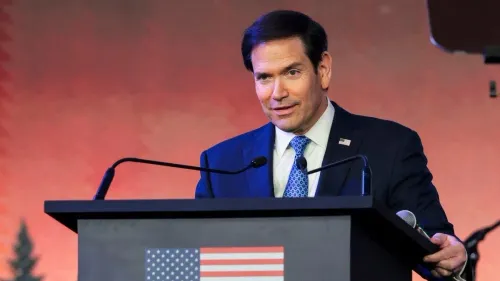
Zelensky publicly endorsed a freeze on October 22, saying, "Yes, right now, we have to freeze." He described a halt along existing lines as "the minimum of what we need from Russia today." In an October 24 interview with ABC News, he put the share of Ukrainian territory under Russian control at 19.3%, rejected the suggestion that Kyiv would be ceding 25%, and reiterated that Ukraine would not recognize Russian sovereignty over occupied territory.
The Kremlin subsequently said Vladimir Putin had agreed "in principle" to renewed trilateral negotiations, with Abu Dhabi considered the most likely venue for a meeting in mid-November. The schedule is not settled. Kremlin aide Yuri Ushakov said on October 28 that talks could take place "after Nov. 4," but that their start would depend on battlefield conditions. Russia had not finalized its delegation, and he ruled out European participation.
A separate, narrowly defined humanitarian truce began in Russian-occupied Oleshky in the Kherson region at 4 a.m. local time on October 27. Its purposes were demining, deliveries of food and medical supplies, and evacuation of the civilians still there. US mediation involving First Lady Melania Trump secured the arrangement, which Ukraine's parliamentary human-rights commissioner, Dmytro Lubinets, confirmed and Russian Chief of the General Staff Valery Gerasimov announced. It was a local operation, not a ceasefire across the front.
What the proposed guarantees would provide
The January 2026 Paris Declaration outlines a security arrangement combining a multinational reassurance force under French and British command, US-led ceasefire monitoring through a sensor network, and an assistance commitment modeled on NATO's Article 5. The troops would operate "away from the contact line." Assistance would require a political decision to activate, and the American commitment would require congressional approval.
According to the OSW Centre for Eastern Studies, France and the UK pledged ground forces reportedly totaling up to 15,000 troops. Turkey was expected to lead the Black Sea naval component, while Poland would handle logistical support.
Modern Diplomacy identifies the distance between the proposed force and the front as a central weakness: a limited Russian advance could test the ceasefire without encountering allied soldiers. Monitoring could establish who violated the agreement, but would not itself stop a violation. An assistance pledge requiring a later political decision would leave the response uncertain. Russia's Foreign Ministry, meanwhile, has said it rejects foreign troops in Ukraine "in any format."
Washington has promised a route toward a more formal commitment. As of December 2025, the White House had pledged to submit security guarantees connected to a potential peace agreement to the Senate for ratification. The Atlantic Council described that pledge as an important indication of continuing bipartisan congressional support.
The funding picture is more limited. The fiscal 2026 National Defense Authorization Act, passed by the Senate in December 2025, included $400 million for the Ukraine Security Assistance Initiative, compared with nearly $14 billion approved by Congress in 2024. The Trump administration requested no new money for the program, instead shifting toward weapons sales to Europe for Ukraine.
Korea's deterrent rests on troops, not monitoring
Modern Diplomacy contrasts that proposed arrangement with South Korea's, where American troops would be exposed immediately to an attack across the line. Their presence functions as a military tripwire: an offensive would involve the guarantor from the outset, rather than leave Washington to decide afterward whether to intervene.
Korea's July 27, 1953, armistice ended the fighting without producing a peace treaty. Washington and Seoul signed their Mutual Defense Treaty ten weeks later, and about 28,500 US troops remain in South Korea. Over 73 years, the front has changed little despite North Korea's development of nuclear weapons and the 2010 sinking of the South Korean corvette Cheonan.
Congress has also placed conditions on reducing that deployment. Section 1268 of the fiscal 2026 defense authorization act, a Senate-originated provision, prohibits spending to bring US Forces Korea below 28,500 troops without independent and extensive reporting requirements. According to the Atlantic Council, the administration opposed the restriction as an infringement on the president's commander-in-chief authority.
The analysis treats Korea as evidence that a durable guarantee must survive changes in the military balance and political priorities. Its comparison with Ukraine concerns not simply the number of foreign troops, but whether their location and obligations make an attack costly for the guarantor to ignore.
Cyprus and Transnistria show different kinds of stability
Other long-running ceasefires offer less direct models. Turkey's 1974 invasion divided Cyprus, leaving a large Turkish garrison in the north and a buffer zone patrolled by the UN force UNFICYP. Ankara invoked the 1960 Treaty of Guarantee when it intervened and has maintained its presence ever since, making the guarantor also the occupying power.
Modern Diplomacy attributes the line's endurance to Turkey's sustained commitment and the Greek Cypriot side's lack of a military means to reverse the partition. EU membership in 2004 offered the latter another path. The result has been half a century without war, but not a political settlement: the UN's Annan Plan failed in a referendum that year, and the side able to reopen the territorial question has had little incentive to do so.
Transnistria illustrates how a frozen conflict can change without renewed combat. A 1992 ceasefire preserved a Russian-backed enclave within Moldova, with roughly 1,500 Russian soldiers guarding it. Since 2022, Ukrainian territory has cut the garrison off from Russia. On January 1, 2026, Ukraine and Moldova closed its remaining land, rail and air supply routes, leaving Moscow unable to reinforce or resupply the force.
The ceasefire has nevertheless survived. Rather than use tanks, Chișinău has relied on customs controls and gas bills. In Modern Diplomacy's assessment, Russia's declining ability to support the enclave is shifting the outcome in Moldova's favor through peaceful pressure.
Karabakh's guarantee failed through repeated tests
Nagorno-Karabakh is the warning at the center of the analysis. The 1994 ceasefire left Armenian forces in control; Azerbaijan recovered most of the territory in 2020 and the remainder in September 2023. The final offensive came three years into a Russian peacekeeping deployment, after months in which Moscow's willingness to enforce the agreement had been tested publicly.
Under the November 2020 ceasefire statement, nearly 2,000 Russian peacekeepers were assigned to safeguard the Lachin corridor, the sole road connecting Armenia with Karabakh. Starting in December 2022, Azerbaijani "eco-activists," followed by a state checkpoint, blocked the route. Armenia's prime minister directly told Putin that the peacekeepers had lost control of it. The International Court of Justice ordered the road reopened in February 2023, but Russian troops did not intervene during nine months of dwindling food and fuel supplies.
Azerbaijan attacked on September 19, 2023. Karabakh's forces surrendered in about a day, and more than 100,000 people, almost the entire Armenian population, fled within a week. Russia completed its peacekeeper withdrawal by June 2024.
Modern Diplomacy argues that the failure was gradual rather than sudden: Azerbaijan tested the limits of Russian enforcement, encountered no effective response, and then launched its offensive. On that reading, an uncommitted foreign force can create false reassurance for the defender while revealing to an attacker how far it can go.
The analysis also acknowledges changes that favored Azerbaijan independently of the peacekeepers' conduct. Oil revenue financed a much larger army equipped with Turkish and Israeli drones. In October 2022, Armenia recognized Azerbaijan's territorial integrity, implicitly including Karabakh. But Modern Diplomacy argues that absorbing shifts in the military balance is precisely a guarantor's role, drawing a contrast with the Korean line's survival after North Korea acquired nuclear weapons. By 2023, it says, Moscow placed greater importance on its relationships with Baku and Ankara than on Yerevan.
Three scenarios, not statistical forecasts
Modern Diplomacy assigns three possible paths approximate probabilities based on its author's analytical judgment, not statistical forecasting. Each depends on assumptions about Russian priorities and the commitments Ukraine's partners ultimately make.
Its base case, assigned roughly 50%, envisages talks after November 10 leading to a ceasefire along current lines in the first half of 2027. European hubs would operate in central and western Ukraine alongside US-led monitoring, but without a ratified American obligation. Exhaustion on both sides would keep the ceasefire intact for at least a year. The key assumption is that Moscow would value rebuilding its forces more than mounting another offensive. Ukraine would gain time, with the benefit depending on how quickly its own military could become an effective deterrent.
The downside scenario, at roughly 30%, follows the Lachin pattern. Within 12 to 24 months, Russia would conduct a limited test below the threshold of renewed war: a blockade presented as humanitarian, the capture of a disputed village, or an energy cutoff framed as a technical disagreement. The rear-area European force would stay out, while monitors documented responsibility without prompting action. Repeated unanswered violations would encourage further probes. Modern Diplomacy argues that this incremental erosion, rather than only a return to full-scale war, is a reconstruction risk that investors and insurers have not yet priced in.
The roughly 20% upside scenario requires Washington to submit a binding assistance commitment to the Senate and at least one allied contingent to deploy close enough to the front to face an advancing force. In this scenario, Russia would accept a ceasefire despite its objections because its economy needed sanctions relief. Of the three paths, the analysis judges this the only one likely to preserve today's line through 2040.
The commitments still to be made
The distinction is between a ceasefire that postpones decisions and one backed by commitments that would be costly to abandon. Modern Diplomacy's comparison is stark: Korea's line has endured for 73 years, while the line established in Karabakh in 2020 survived for less than three.
For Ukraine, the concrete tests remain whether the White House follows through on submitting an assistance obligation for congressional ratification, and whether allied troops deploy where a Russian advance would encounter them. Those decisions would determine how closely the proposed security arrangement resembles a defended boundary rather than a monitored pause.