A deadline for court action
The veterans asked U.S. District Judge Tanya Chutkan on Oct. 22 to decide their request by Nov. 4, the day before the National Capital Planning Commission is scheduled to consider the arch's final site and building plans.
Their filing followed an administration notice a day earlier saying construction could "commence immediately" after the Nov. 5 meeting if the commission approves the plans. The notice fulfilled the government's earlier commitment to provide at least two weeks' warning before construction.
Chutkan has not blocked construction in the case, which began in February. A separate order she issued in September requires the government to give at least 48 hours' notice before "engaging in any activity" around the proposed site.
The veterans accused the administration of advancing the project through site testing, architectural work and reviews by commissions aligned with it while neglecting Congress. They wrote that officials had not obtained, or even sought, approval from "the one body that, by law, must authorize the project: Congress."
The Justice Department did not immediately respond to MS NOW's request for comment.
Congressional authority and the cemetery's historic setting
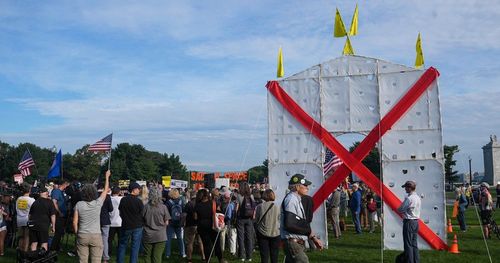
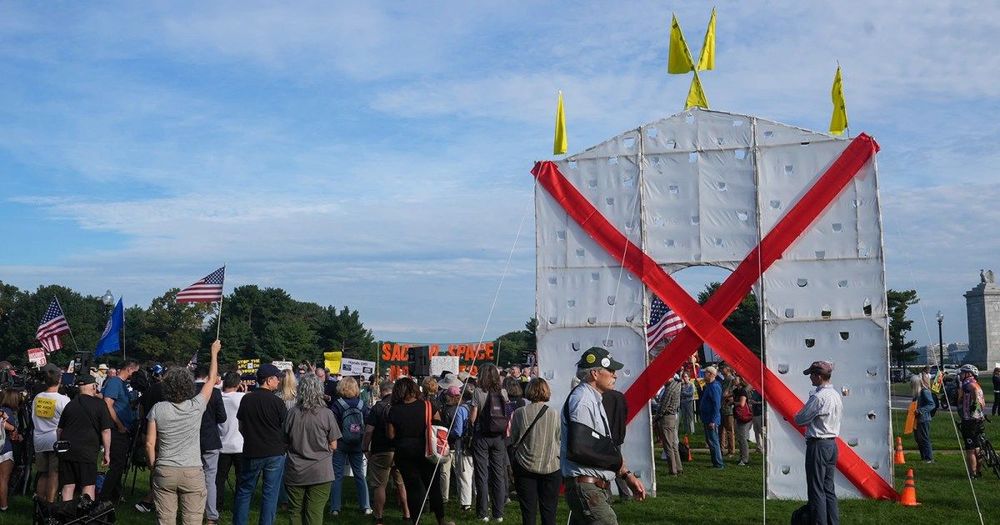
The three veterans brought the lawsuit with the watchdog organization Public Citizen. Along with their congressional-authorization argument, they contend that an arch at Memorial Circle would obstruct the historic view connecting the Lincoln Memorial and Arlington National Cemetery. Their lawsuit describes that nearly century-old sightline as a symbol of national reunification after the Civil War.
The administration maintains that Congress has already authorized the project, citing a 1925 proposal for two tall columns near the planned arch site. That proposal was not for an arch and differed substantially from Trump's design.
Historic-preservation concerns also appear in the National Park Service's own review. Its August 2026 assessment under Section 106 of the National Historic Preservation Act identified adverse effects on 37 historic properties, including the Lincoln Memorial, Arlington National Cemetery, Arlington House, the Kennedy gravesite, the U.S. Capitol, the Jefferson Memorial and the Washington National Cathedral.
An alternative location received little attention. In a June letter to the Park Service, D.C. state historic preservation officer David Maloney suggested a new traffic oval near the Frederick Douglass Memorial Bridge in southeast Washington. He argued that the arch would better fit the scale of the 288-foot Capitol dome there and would enhance, rather than detract from, the city's monumental landscape. NPR reported that the commission briefly mentioned the idea at its July meeting but largely left it unexplored.
Meanwhile, the Advisory Council on Historic Preservation voted in late July to rewrite Section 106 rules nationwide. NPR reported that the council, whose members are mostly Trump allies, sought to ease federal construction on historic properties by narrowing what qualifies as a historic site or an adverse effect and reducing required public input. The proposed language entered a 30-day public comment period.
From anniversary monument to proposed military use
Trump unveiled his plans in October 2025 for a gilded, Arc de Triomphe-style monument celebrating the country's 250th anniversary. At 250 feet, it would tower over the nearby 99-foot Lincoln Memorial. Its proposed home, Memorial Circle, is a traffic roundabout between Arlington National Cemetery and the bridge across the Potomac River into Washington.
The idea predates Trump's announcement. According to Reason, Catesby Leigh, a former National Civic Art Society research fellow, first publicly suggested an arch at Memorial Circle in 2024. Society President Justin Shubow presented the idea to Trump in 2025. Initially envisioned as a temporary anniversary structure, it later became the subject of discussions about a permanent monument.
D.C.-based classical architect Nicolas Leo Charbonneau is designing the arch for the White House. Reporting identifies him as an architect at Harrison Design.
Trump expanded his description of the project in September, announcing a "top grand Military Complex/Triumphal Arch." He said it would house and store drones for rapid use, accommodate snipers on the roof and plaza, and hold large quantities of sniper ammunition. The final plans sent to the Interior Department and the planning commission, however, describe neither a military complex nor a national security purpose.
The proposed height also exceeds Washington's 130-foot building limit. As of September 2026, the project was awaiting the planning commission's final approval for an exemption.
County lawsuit and aviation concerns
The Arlington County Board filed a separate lawsuit earlier in October seeking to stop construction. It alleges that the administration is rushing the project and bypassing a full review. Although the Park Service says it has not made a final construction decision, the county argues that the accelerated review appears to be a pretext for justifying a project Trump has repeatedly ordered it to build.
The county also challenges the proposed military use. It says storing ammunition and staging drones and snipers so close to tourists and commuters would "dramatically worsen" public-safety harms and accident risks. No judge has yet ruled on the county's lawsuit.
The location has drawn objections from aviation representatives as well. The arch would stand directly in the flightpath to Reagan National Airport, roughly 3,000 feet from the airport within an approach and departure corridor. Association of Flight Attendants-CWA President Sara Nelson warned that it would create a dangerous obstruction in an already congested flightpath, where safety concerns persist after the fatal 2025 collision between a commercial airplane and a military helicopter over the Potomac.
Reason reported that the Federal Aviation Administration determined the arch itself would not pose a hazard to aircraft but required an eternal flame on top to alert pilots. The architects have proposed adding the flame in response to aviation officials' recommendation.
Public funding and years of construction
The White House had not issued an official cost estimate as of September 2026. Reason cited media estimates suggesting a price of as much as $100 million, while public agencies had already committed money to the project.
The National Endowment for the Humanities set aside $15 million for the arch and separately awarded the National Civic Art Society $30,000 for architectural plans, renderings and models. The Park Service awarded Portland-based engineering firm OTAK a $500,601 contract covering environmental assessment and compliance work at Memorial Circle.
Planning documents released by the Interior Department project construction lasting two to three years, with work running up to 20 hours a day. Preservationists and veterans say the near-constant noise would disrupt burials at the adjacent cemetery.