
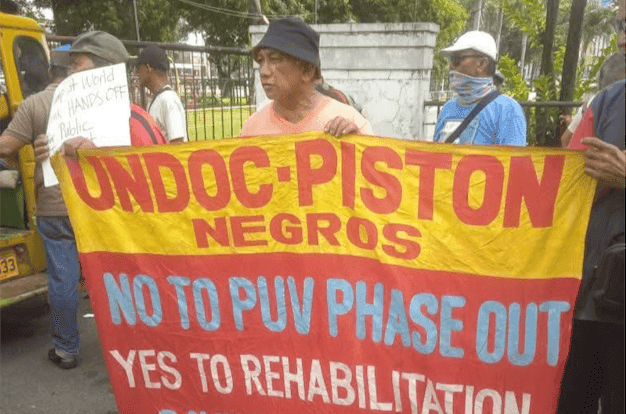
Protests and a disputed scrapping claim
The alliance brings together BACODNO-MANIBELA, Kabakod Negros Transport Coalition (KNETCO) and UNDOC-PISTON, previously fragmented groups now opposing the proposed Public Transport Modernization Program (PTMP), according to Rappler.
On October 22, the groups left a World Bank-Department of Transportation (DOTr) dialogue at Seda Hotel-Bacolod and protested outside. They accused organizers of staging a discussion intended to secure their support rather than address their objections. They stepped up their campaign on October 26, when the Electric Vehicle Summit began at Ayala Malls Capitol Central.
At a news conference that day, BACODNO-MANIBELA president Rudy Catedral accused the DOTr of using the World Bank's involvement to disguise the failure of its earlier modernization program. He said the new proposal would drive traditional operators out of business.
One point of contention is whether three traditional jeepneys would be scrapped for every modernized replacement. Gerry Llena, the Land Transportation Franchising and Regulatory Board's regional director for Negros Island, told Rappler on October 26 that he had yet to hear both sides, but called that allegation "just a myth."
"We are guided by the so-called Local Public Transport Route Plan (LPTRP), so we cannot just scrap jeepney units, or else we will face an even greater shortage," Llena said.
Vehicle costs and cooperative debt
The PTMP replaces the name of the nine-year-old Public Utility Vehicle Modernization Program (PUVMP), introduced through DOTr Department Order No. 2017-011. The earlier program calls for a gradual nationwide shift from traditional jeepneys to modernized vehicles with Euro 4-compliant engines. With each vehicle costing more than P2 million, operators were required to organize into cooperatives before seeking financing from the Land Bank of the Philippines or the Development Bank of the Philippines (DBP).
Rappler described the earlier program as apparently failing, citing approximately P5 billion in debt involving the two government banks. In Negros Occidental, eight of the Bacolod Modernized Jeepney Transport Association's 11 cooperatives face significant problems. Banks could repossess 329 vehicles belonging to the association.
Other reports provide further details on repayment difficulties. The Philippine Daily Inquirer reported on October 10 that World Bank Group senior transport specialist Bowen Wang cited the group's estimates showing defaults on about 60 percent of loans taken out by transport cooperatives through special lending facilities, totaling P5.22 billion.
In a September 18 report, The Philippine Star cited DBP figures showing about P4.1 billion in past-due PTMP loans to public utility vehicle cooperatives, or 55 percent of the bank's P7.5 billion in lending. Those overdue loans affected up to 2,753 of the 3,249 vehicles financed. Land Bank separately reported P2 billion in overdue loans across 51 borrowers.
The DOTr issued a P1.5 billion notice of cash allocation to help cooperatives meet outstanding amortization payments. Its allocation in the proposed 2027 budget, however, was P177 million for the PTMP, compared with the P2.17 billion it had requested, The Philippine Star reported.
Financing proposals and pilot plans
According to Rappler, the World Bank is prepared under the PTMP to lend to established transport companies and corporations with strong performance records rather than to cooperatives. The plan calls for all modernized jeepneys to move from standard Euro 4 engines to Euro 4L-equipped units.
Once obstacles are cleared, the DOTr plans to pilot the program in Bacolod, Iloilo, Cebu, Baguio and General Santos, along with the National Capital Region, Rappler reported.
A model presented in Baguio offers additional details on a proposed financing arrangement. At a public transport modernization convention reported by the Philippine Daily Inquirer on October 10, Wang proposed having local governments or private leasing firms pay for vehicles and spare parts. Transport groups could obtain the vehicles on lease-to-own terms, with payments covered through long-term service contracts with the city.
Under that proposal, traditional jeepneys could continue running while the transition to modern electric vehicles takes place. Baguio was designated as the pilot city, with official development assistance from World Bank Group banks supporting the first six years. Mayor Benjamin Magalong said, following talks with Transportation Secretary Giovanni Lopez, that the project would be developed for implementation within six months.
Operators seek testing, rehabilitation and legal action
KNETCO president Lilian Sembrano said a full rollout of either Euro 4L-compliant or electric vehicles would be premature without assurances about capacity, reliability and sustainability. She called for a one-year trial in places without transport service entities to assess the effectiveness of World Bank-funded electric vehicles, arguing that adding them to routes already served by those entities would complicate operations.
Sembrano said operators' greatest fear was that the DOTr would establish a center where traditional jeepneys would be taken for demolition. She questioned how operators could afford World Bank-financed vehicles priced at P3 million to P4 million each and urged consideration of rehabilitation first. She also said the groups had not been shown a PTMP feasibility study.
The groups intend to mount a legal challenge because the modernization program rests on a DOTr department order rather than a law, Sembrano said. She asked Bacolod Mayor Greg Gasataya to intervene in negotiations between the department and the World Bank.
UNDOC-PISTON president Rodolfo Gardoce Jr. warned that his group was prepared to stage a mass transport stoppage, known as "untat byahe," if the proposal proceeds.
Concerns over routes, fare collection and service
The Negros groups also object to proposed changes in routes and fare collection. Digicast Negros reported on October 21 that they expected route rationalization in Bacolod, potentially eliminating existing routes and combining them into single corridors.
They opposed the proposed Automated Fare Collection System, a cashless payment mechanism, because they feared private companies' involvement in collecting fares could increase commuters' costs.
Separately, Para Commuters' Network criticized the World Bank's proposed PTMP overhaul as "anti-commuter by design" in a statement reported by The Manila Times on October 18. The advocacy group argued that it would reduce transport availability and push fares higher.
Its convenor, Nanoy Rafael, said the nationwide supply of public utility vehicles had dropped by as many as 190,000 since the jeepney phaseout began, with only about 8,000 modern fleets replacing them as of August 2026.