
Court disclosures under scrutiny
At the Oct. 30, 2026, hearing, Reyes questioned Stanley Woodward Jr. for more than two hours, testing his explanations against President Donald Trump's Truth Social posts about the project. The inquiry will assess whether government officials' conduct may have breached professional or ethical obligations, rather than make a final determination that lawyers committed violations.
Reyes plans to appoint a special master, a judicial officer she said would have "full investigatory powers." The Justice Department has five business days to object to the appointment. If the government rejects her choice, Reyes said she will lead the inquiry herself.
One issue is whether the government acted in bad faith when it notified the court of impending tree removals. Reyes also wants to establish whether lawyers directed acting National Park Service Director Jessica Bowron to leave information about possible redevelopment plans out of a declaration.
The review will also examine whether lawyers instructed Kevin Griess, superintendent of National Mall and Memorial Parks, to put particular information about budgetary resources into a declaration. Reyes ordered officials to retain all relevant documents so the inquiry could proceed "without the loss of evidence."
Public announcements and court filings
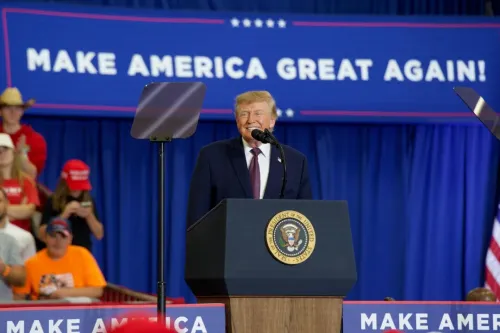
The administration's statements in court have differed from Trump's public account of the project. Earlier in October, he announced that extensive redevelopment would require the course to close for 15 months beginning Nov. 15 and said he had assigned golf course architect Tom Fazio to the project.
In an Oct. 18 Truth Social post, Trump said the Interior Department and Fazio had "developed a plan to build a World Class Championship Golf Course on the site." Yet Interior and Justice officials repeatedly told the court that no finalized plan existed. Representatives of those departments and the National Park Service had also been unable to confirm the plans' existence or scope.
The Justice Department acknowledged in an Oct. 28 filing that the park would close Nov. 15. It also said the National Park Service would submit Fazio's design to the National Capital Planning Commission, which is scheduled to consider it at its Dec. 3 meeting.
A new lease agreement requires National Links Trust, the National Park Service's operator, to end its East Potomac operations by the close of business on or before Nov. 15, 2026. The organization will retain responsibility for two other public golf courses under a 50-year lease.
The planned closure reaches beyond the course: Recreational areas and much of the three-mile perimeter loop used by runners and cyclists will also become inaccessible to the public. Woodward told the court that seawall repairs would cost between $150 million and $400 million.
Tree removal and the environmental lawsuit
The DC Preservation League brought the lawsuit in February, arguing that redevelopment could breach environmental requirements and damage a historically significant public space.
Reyes had required the government to notify the court before undertaking substantial construction. After crews cut down more than 400 trees at the course, she extended restrictions barring additional irreversible changes.
On Oct. 26, Reyes issued a preliminary injunction. Her 70-page opinion found that the government likely violated the National Environmental Policy Act by dividing the larger project into smaller components, avoiding a full assessment of their cumulative environmental effects. She described the administration's explanation that tree-cutting was a separate undertaking as "pretextual."
The administration appealed the injunction to the U.S. Court of Appeals for the D.C. Circuit. Trump had said the Interior Department would "immediately appeal" the ruling.
A request to restrict project funding
Rep. Jared Huffman, the leading Democrat on the House Natural Resources Committee, asked congressional appropriations leaders to prevent seawall funding from being used to advance the golf course renovations.
In an Oct. 29 letter to House and Senate appropriations leaders, Huffman proposed barring federal spending on redesigning or expanding the courses, changing roads, cutting down healthy trees, adding buildings or reshaping the land.