Who benefits from foreign investment?
Wolfers, a University of Michigan professor, drew the distinction between employment and ownership in a Wednesday post on X: "When a foreign company builds a factory here, the jobs are American. The profits aren't."
He added: "Selling away more of America is a strange thing for a president to brag about."
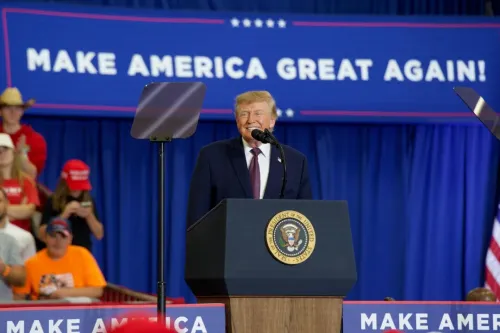
Trump cited the $21 trillion figure earlier this month during a rally in Clarksville, Tennessee. "We have $21 trillion being invested in our country, more than at any time, for any country anywhere in the world," he said. Benzinga reported that the White House investment tracker totals $11.3 trillion at face value.
The composition of the White House list has also drawn scrutiny. In an Oct. 11, 2025, fact-check, CNN's Daniel Dale found that major entries represented something other than capital investment. The White House had described the $1.2 trillion associated with Qatar as an "economic exchange," rather than an investment commitment to the United States. Another $500 billion attributed to India referred to a goal of more than doubling bilateral trade to that amount by 2030, not an Indian investment pledge.
That earlier review put the list's total at $8.8 trillion, roughly half the $17 trillion Trump was claiming at the time.
Trade deficits and manufacturing employment
Wolfers also argued that the administration's desire for more foreign investment conflicts with its aim of reducing the trade deficit. "When the president says that what he wants is more foreign investment, it is necessarily the case that that will lead to a larger trade deficit. They're two sides of the same coin," he said.
Commerce Department figures released Wednesday showed an unexpected 2.1% increase in the September U.S. goods trade deficit, to $134.9 billion. That was the largest gap since March 2025, with imports reaching a record $344.1 billion.
In a separate assessment published Sept. 2, 2026, in Platypus Economics, Wolfers compared annual trade figures under the tariff program. He reported that the goods deficit reached a record of about $1.24 trillion in 2025, the program's first full year, versus $1.212 trillion in 2024. Including services, however, the total deficit was about $902 billion in 2025, compared with about $904 billion a year earlier.
The same analysis put U.S. manufacturing employment in July 2026 about 62,000 jobs below its January 2025 level. Wolfers described that as a decline of roughly half a percent, while employment elsewhere in the economy increased.
Wolfers also cited a Dallas Fed survey asking 271 Texas firms how higher tariffs would affect their businesses that year. A negative net impact was expected by 59%, compared with 4% expecting a positive impact. Just 5% planned to shift production to the United States.
Audi's planned U.S. factories
One investment Trump highlighted at a Georgia rally on Saturday was Audi's planned assembly plant in the state. He said the Volkswagen AG premium brand would invest about $4 billion and create about 4,500 jobs. Audi currently has no U.S. plant; tariffs cost the company about $1.4 billion last year.
Georgia Governor Brian Kemp's office said on Oct. 24, 2026, that Audi's first U.S. manufacturing facility would occupy the Middle Georgia Megasite in Peach County, near Macon. The company's schedule calls for grading to start in 2027, followed by construction in 2028. Full production is expected in 2031, with annual capacity of 200,000 vehicles.
A U.S. official told Reuters that the Georgia factory is expected to assemble the Audi Q7, Q8 and Q9 SUVs.
Audi also plans annual production of 25,000 vehicles in South Carolina, CNBC reported on Oct. 24, citing a U.S. official. Volkswagen will assemble those vehicles at the $2 billion Scout Motors plant under construction in Blythewood, near Columbia. Scout Motors is Volkswagen's off-road brand.
The expansion plans come amid declining Audi sales. CNBC reported that sales had fallen for two consecutive years, with a further 7% drop in the first half of 2026 amid fierce competition in China and U.S. tariffs. U.S. sales were down 16% this year. The report also identified Audi's Neckarsulm facility in southwest Germany as one of four German Volkswagen plants that could close after 2030.
Market trading
The State Street SPDR S&P 500 ETF Trust (NYSE: SPY) finished Wednesday at $772.31, a gain of 0.34%. It was down 0.45% in early premarket trading Thursday, according to Benzinga.