
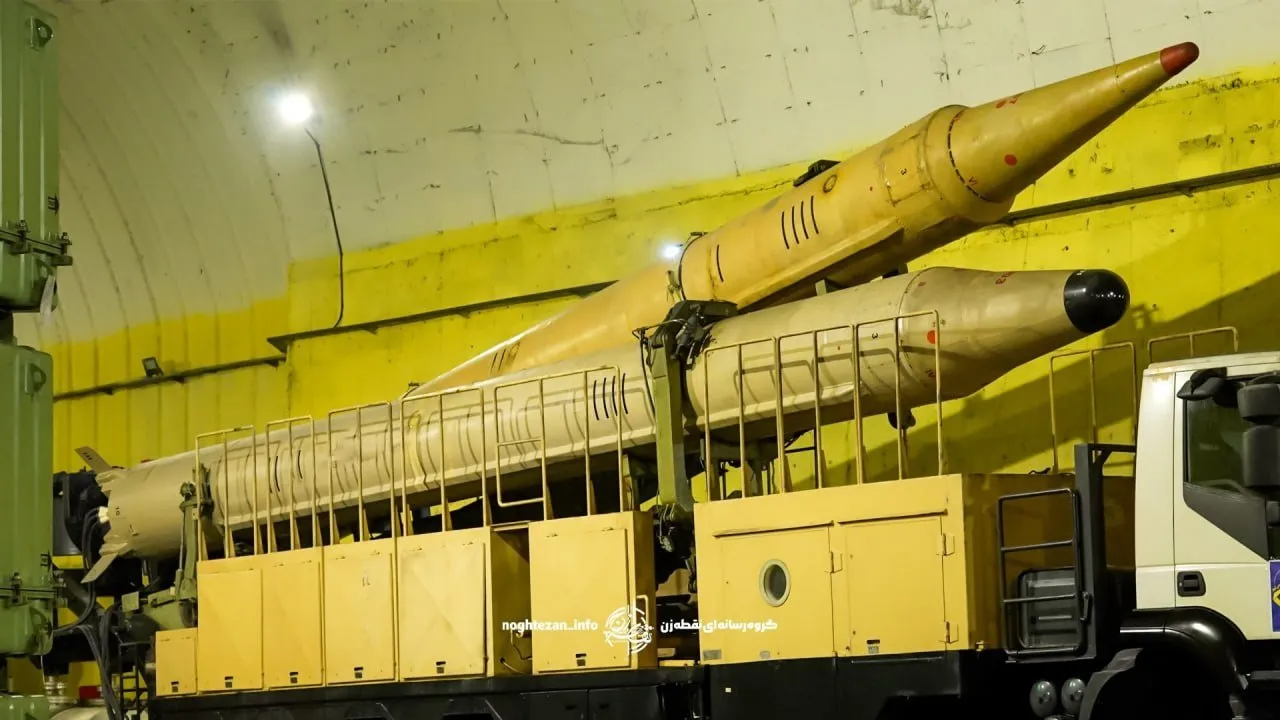
Launcher displayed during commander's tour
The video accompanied a November 21 tour by IRGC commander Major General Ahmad Vahidi. IRIB's footage showed tunnels stretching for kilometers, with hundreds of missiles and launchers inside. Clash Report shared the video on X that day, and World Israel News characterized the release as propaganda.
Al Jazeera, citing IRIB, reported that the launcher is intended for simultaneous launches. The broadcaster said liquid-fueled missiles launch vertically and have speed-control capabilities that can help them overcome air defenses.
Iranian state media also claimed improvements in the range and accuracy of the country's latest missile generations, along with guidance capabilities that do not depend on the U.S. Global Positioning System, or GPS, Al Jazeera reported on November 22.
Vahidi's visit came after the IRGC Aerospace Force announced a new underground facility on November 10, according to the semiofficial Tasnim News Agency. The IRGC says it has relocated its missile and drone production lines underground from surface facilities.
During remarks recorded at the site, IRGC Aerospace Force commander Brigadier General Seyyed Majid Mousavi said, "The aerospace capabilities have expanded in the interval between the two conflicts," according to The National.
Missile display amid blockade and war
Analysts cited by Al Jazeera said the display was intended in part to restore Iranian deterrence. The U.S.-Israel war began in late February 2026, and by late November, a U.S. naval blockade had disrupted Iran's oil exports.
The analysts described an economy in recession, with very little oil leaving Iran. Separately, World Israel News reported that President Donald Trump had threatened renewed strikes after New Year's if nuclear talks failed. He also warned that Iranian vessels trying to breach the blockade would be sunk.
Underground sites and their construction
The latest footage follows reports of repairs at underground missile facilities. In a November 22 report, The National cited CNN's May analysis of Airbus satellite imagery: Iran had restored access through 50 tunnel entrances out of 69 that had been struck across 18 underground missile sites.
The National also examined questions about the construction of Iran's underground "missile cities." German manufacturer Herrenknecht began supplying tunnel-boring machines for civilian projects in Iran in the late 1990s, including metro systems and water infrastructure. It left the Iranian market in 2018.
The report identified Khatam Al Anbiya, an IRGC-controlled construction conglomerate, as central to those questions. The group has been linked both to civilian tunneling projects and to Iran's missile and nuclear programs.