Define the work before selecting the equipment
Begin by identifying the workpiece from its label or technical documentation rather than its appearance. Steel, stainless steel, ceramic and carbide behave differently under heat and abrasion. Removing a weld also demands a different approach from shaping an edge or polishing a small area.
Consider how the tool will reach the surface. Tight corners may call for a smaller wheel, while a wider one can be easier to control across a broad, flat area. Thin parts require particular attention to pressure: pushing too hard can produce heat, discoloration and uneven wear. Light passes often offer better control.
Tool types serve different purposes. For portable work across larger metal surfaces, an angle grinder is an option, although rapid material removal can leave uneven marks. A bench grinder provides steadier handling for small-part shaping and sharpening. Die grinders reach confined slots and detailed edges; belt grinders suit broad surfaces.
Use the tool and abrasive manufacturers' instructions to narrow the choice, then test on scrap when possible. Grip, vibration and dust control also deserve attention, particularly for extended work.
Choose the abrasive and read its grit designation
For many steel applications, aluminum oxide is suitable. Silicon carbide is often appropriate for glass, stone and other hard, brittle materials. The desired finish then helps determine grit: coarse abrasives remove material faster but may leave deep scratches, while finer abrasives work more slowly and leave a smoother surface. A rough steel edge, for example, may need a medium grit followed by a finer one.
A grit number needs to be read with its grading system. According to NovoAbrasive, the two main systems are the European FEPA "P" scale, defined by ISO 6344, and the North American CAMI/ANSI scale. Labels such as P240 and 220 therefore do not use the same designation system.
The scales are nearly equivalent across coarse grades from P40 to P180, but their specifications diverge above about 220. FEPA sets tighter grain-size tolerances and explicitly limits oversized particles. Its separate "F" scale applies to bonded abrasives, including grinding and cutting discs. Check the scale on the label and consult the manufacturer before comparing products.
FEPA, the Federation of European Producers of Abrasives, was established in Paris in 1955. NovoAbrasive says it brings together more than 220 companies in 17 European countries, representing over 90% of European abrasives production.
Verify dimensions, power and speed
Wheel size involves a trade-off between coverage and handling. A compact grinder can be easier to manage along narrow edges or overhead. A larger wheel can cover a broad surface faster, but requires more clearance and adds weight. Stay within the machine's permitted wheel diameter; an oversized wheel is not an acceptable way to increase capacity.
Match motor power to the workload as well. Occasional light sanding may not require a high-powered machine, while thick steel or prolonged grinding can strain a small motor. Extra power is not useful if the resulting weight makes the tool difficult to control.
Before mounting an accessory, verify its arbor size, diameter and approved materials against the machine's specifications. Its speed rating must be at least as high as the grinder's no-load speed. On variable-speed equipment, use only settings permitted by the accessory manufacturer.
Assess handling and vibration exposure
Hold a prospective tool in the position the work requires. Check whether the grip, trigger and balance allow steady control; a nose-heavy tool can put strain on the wrist during overhead use. Tingling fingers during even a short trial are a reason to stop and reassess the equipment and task.
AccessoryFit, citing UK Health and Safety Executive guidance, says employers without better real-use data should assume hand-arm vibration of about 7 m/s² for angle grinders measuring 100 to 180 mm. At that vibration level, roughly one hour of trigger time takes a user past the UK daily exposure action value.
Durability checks should go beyond the housing. Examine handle security, guard construction, replacement-part availability and whether the cord or battery connection suits the workspace.
Check guarding and injury-prevention requirements
U.S. OSHA regulation 29 CFR 1910.215 requires abrasive-wheel machines to have safety guards covering the spindle end and the projecting nut and flanges. On offhand grinders, the work-rest gap must not exceed one-eighth inch, and the adjustable tongue-guard gap must not exceed one-fourth inch. The regulation also requires inspection and a ring test for cracks immediately before each wheel is mounted.
An AccessoryFit analysis of the Consumer Product Safety Commission's NEISS sample puts the estimated number of U.S. emergency-department-treated injuries involving workshop grinders, buffers and polishers at 40,000 in 2024. The estimate has a 95% confidence interval of 31,899 to 48,047 injuries.
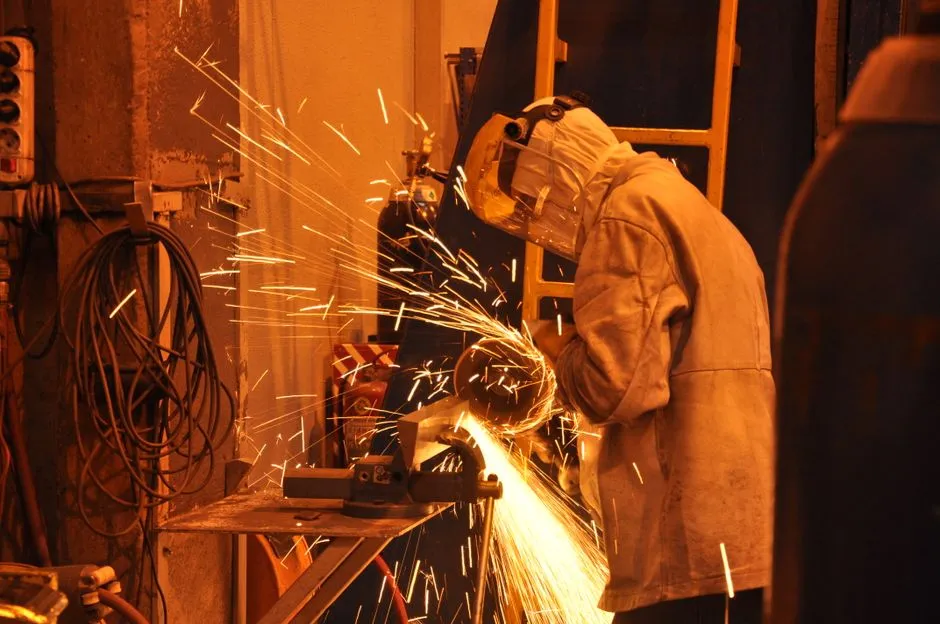
That federal product category includes both bench and angle grinders, rather than angle grinders alone. Eyes accounted for the injured body part in 48.3% of cases. Use eye protection, keep the required guard fitted and secure the workpiece before grinding.
Weigh market choice against upkeep
Grand View Research estimated the global abrasives market at $47.3 billion in 2023 and projected annual growth of about 4.6% through 2030. Its U.S. estimate was $4.22 billion in 2023, with a projected compound annual growth rate of 5.0% from 2024 through 2030, reaching $5.86 billion.
In the U.S. market, automotive and transportation generated the largest revenue share in 2023, at nearly 37%, while bonded abrasives accounted for more than 43%. Those figures describe demand, not the suitability of a particular wheel for an individual job.
Include maintenance in the buying decision. Before each use, disconnect a corded machine or remove the battery, then check the cable, handle, guard and wheel for damage or looseness. Replace damaged components and keep wheels stored flat in a dry location.
A checklist cannot establish how a setup will perform on the workpiece. Where possible, make a test cut on scrap to assess handling and finish before committing to the full surface.