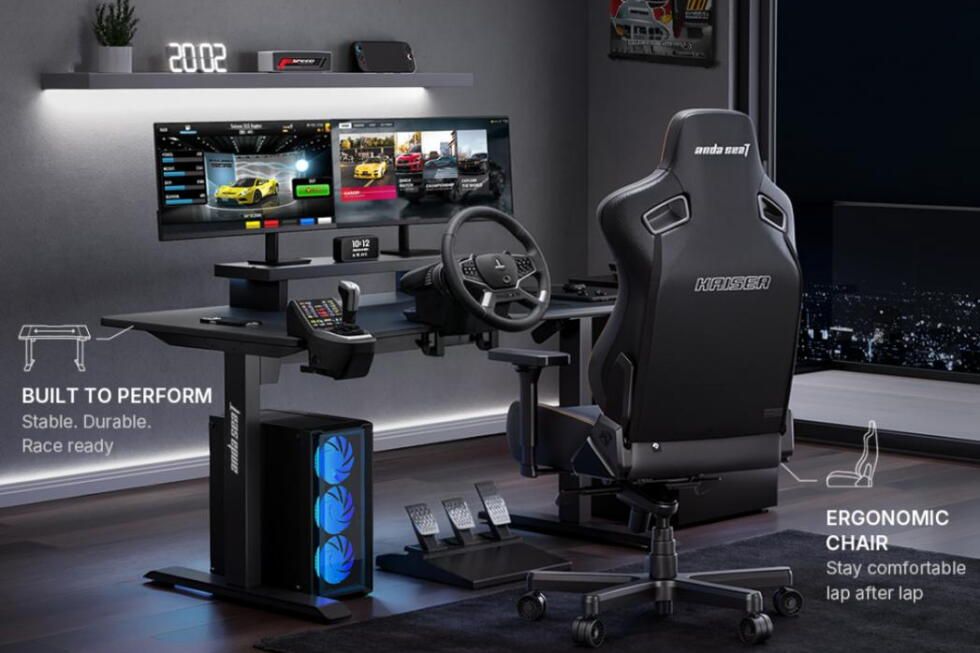
AndaSeat Kaiser 4 Gaming Chair Designed Around Body Diversity, Not Average User
AndaSeat has detailed the design philosophy behind its Kaiser 4 Series gaming chair as new ergonomics guidance highlights a persistent challenge in furniture design: products built around an "average" user often fail to accommodate the actual range of people who use them.
The International Organization for Standardization published ISO/TR 5716:2025 titled "Ergonomics — Application of anthropometry in product and workspace design" in November 2025. The technical report outlines best practices for considering body size and shape in design, noting that products interact with multiple user attributes simultaneously and require multivariate approaches for accurate accommodation estimates.
The Canadian Centre for Occupational Health and Safety, a federal agency established in 1978 to provide impartial health and safety information, reinforces this point in its office chair guidance. CCOHS states that a chair marketed as ergonomic may still prove unsuitable for particular individuals due to height, width or other dimensional mismatches. The agency describes ergonomics as matching furniture to individual body dimensions rather than treating "ergonomic" as a universal product characteristic.
Two Sizes Address Multiple Body Dimensions
Chair design involves several body measurements simultaneously. Height alone does not determine shoulder width, hip width, thigh length or torso length, meaning two people of similar stature may require different seat depths, backrest dimensions or armrest spacing.
This complexity has been documented in ergonomics literature since the 1950s, when researcher Lieutenant Gilbert S. Daniels demonstrated that when averaging 10 physical dimensions, less than 4% of Air Force pilots matched the average profile across all dimensions.
AndaSeat developed the Kaiser 4 around adjustable ranges rather than a single size. The company offers L and XL configurations with structural differences beyond weight capacity.
The L model features an approximately 18.50-inch seat depth, 19.30-inch overall seat width and a backrest measuring approximately 32.28 inches high by 21.26 inches wide. The XL model expands seat depth to approximately 20.08 inches, overall seat width to 21.26 inches and the backrest to approximately 34.05 inches high by 22.44 inches wide.
For context, OSHA's recommended seat pan depth range for most office chairs is typically 15.5 to 17 inches, with guidelines that users should maintain 2-4 inches of clearance between the back of their knees and the front of the seat. AndaSeat's extended depth range of 18.50 to 20.08 inches exceeds typical office chair specifications.
The L model targets users approximately 150-180 cm tall and below 120 kg, while the XL model is designed for users approximately 181-210 cm tall with a recommended weight range of 80-180 kg (up to approximately 395 pounds).
Armrests Accommodate Shoulder Width Variation
Body-width differences extend above the seat. CDC anthropometric data shows average shoulder breadth for adult males in the U.S. is approximately 16.1 inches and for adult females approximately 14.4 inches, with variation at the 5th and 95th percentiles differing by 3-4 inches.
The Kaiser 4 addresses this with 6D armrests providing 7 cm of vertical adjustment, 4 cm of forward-and-back movement and up to 18 cm of lateral positioning through rotating arm structure. The arm pads rotate through 180 degrees, complete arms rotate through 360 degrees and pads can tilt upward by 20 degrees.
CCOHS recommends armrests that provide even support and can be positioned according to individual users rather than forcing shoulders or elbows into predefined arrangements. For larger users, lateral adjustment is particularly relevant because fixed-distance armrests can narrow the usable seating envelope even when the seat itself is sufficiently wide.
Lumbar Support Addresses Torso Length Variation
Torso length, spinal curvature and preferred sitting depth vary among users. The Kaiser 4 uses a gas-spring-powered lumbar mechanism extending through a 24-degree range and locking at any selected angle. Inside that structure, a separate four-way adjustment system provides 76 mm of vertical movement and 30 mm of depth adjustment.
These controls separate three aspects of fit: where lumbar support contacts the back vertically, how far the support projects forward and the overall angle at which the structure meets the user. This is especially important across a wide body-size range, as a larger chair does not mean every larger user shares the same lumbar curve or contact preference.
Movement Features Address Static Posture Risks
OSHA warns that undersized chair components can restrict movement and provide inadequate support. Research indicates that static postures maintained for more than 20-30 minutes without position changes can lead to discomfort and tissue stress.
The Kaiser 4 combines its larger seat and backrest dimensions with up to 135 degrees of backrest recline and a 15-degree rocking range. The magnetic memory-foam head pillow can be repositioned vertically across approximately 20 cm.
These features are designed to preserve usable space and configurable contact points during seated periods, not as substitutes for standing or moving away from the chair.
Design Recognition and Market Context
The Kaiser 4 Series received a Gold award at the 2024 French Design Awards in the Product Design – Workplace & Office category, an annual international competition evaluating entries across product design, architecture and digital design categories. The award listing identified ergonomic design and user-centered product development among central elements of the chair.
The gaming chair market has grown significantly in recent years, valued at approximately $1.8 billion in 2023 and projected to reach $3.2 billion by 2030, driven by increasing ergonomic awareness among gamers and remote workers.
Founded in 2007, AndaSeat develops ergonomic seating and workspace products for gaming, professional and home environments. The company's design process incorporates anthropometric research, user behavior analysis, adjustable support systems and material engineering across its product portfolio.