
What is planned at Palazzo Barberini
A press presentation is scheduled for November 25, 2026; the exhibition's loans remain undisclosed until then. The show completes a three-year program at the national gallery of ancient art, following Bernini e i Barberini and an exhibition devoted to Vermeer's Woman in Blue Reading a Letter.
Rome last devoted an exhibition to Velázquez in 2001, when Palazzo Ruspoli presented Velázquez. Il suo terzo viaggio in Italia. That title referred to a possible third Italian visit, a hypothesis that has never been definitively established.
An early connection to the Barberini family
Velázquez's dealings with the Barberini family began before either of his two documented Italian journeys. In 1626, Cardinal Francesco Barberini, Pope Urban VIII's nephew, visited Philip IV's court in Madrid on a diplomatic mission. The 27-year-old Velázquez had been the king's painter for three years and received commissions for portraits of the cardinal and the Count-Duke of Olivares.
The cardinal's portrait disappointed the delegation. According to the diary of Cassiano dal Pozzo, an intellectual accompanying the mission, it was considered too dark and severe. The visitors turned to another Madrid painter, Juan van der Hamen, for a replacement.
Nevertheless, Cardinal Barberini intervened on Velázquez's behalf to secure an annual pension from Urban VIII. Paid from ecclesiastical revenues, the 300-ducat allowance was an exceptional privilege for a married man, Arte.it reports. Velázquez received it before he had ever visited Italy.
The Olivares commission returned to attention in July 2026. Salvador Salort-Pons, director of the Detroit Institute of Arts, identified a small portrait of Olivares in armor as the painting made for the 1626 mission. Long held in Italy, it was documented in a private collection in Asti during the 20th century.
The Getty Museum in Los Angeles acquired the portrait about two months before November 18, 2026, making it the first Velázquez in its collection. It will be a centerpiece of Velázquez & Olivares: Early Years at Court at the Detroit Institute of Arts, scheduled for January 24 through July 25, 2027. Those dates overlap with the Rome exhibition.
From studying Italian painting to buying for the king
Velázquez's first Italian journey, in 1629–1631, centered on studying artists including Titian, Raphael and Michelangelo. Peter Paul Rubens probably encouraged the trip after visiting Madrid on a diplomatic mission in 1628. The two painters toured the royal collections at the Escorial together; biographer Antonio Palomino credited that encounter with helping persuade Velázquez to study Italian painting firsthand.
Before returning to Madrid in early 1631, Velázquez made a final stop in Naples, where he met Jusepe de Ribera.
He returned to Italy in 1649–1651 as an established painter charged with acquiring art for Philip IV. His work took several forms: purchases of paintings by Titian, Tintoretto and Veronese in Venice; dealings in ancient sculpture and casts in Rome; and the recruitment in Bologna of quadraturists Angelo Michele Colonna and Agostino Mitelli to decorate new rooms at Madrid's Alcázar.
During this second stay, Velázquez also painted figures at the papal court, among them cardinals Camillo Massimo and Camillo Astalli Pamphilj, and Innocent X's powerful sister-in-law, Olimpia Maidalchini. He gained admission to both the Accademia di San Luca and the Congregazione dei Virtuosi al Pantheon.
His portrait of Juan de Pareja, his assistant and enslaved servant, went on display beneath the Pantheon's portico on March 19, 1650. Palomino described an extraordinary response from the artists who saw it. Later that year, Velázquez signed the document granting Pareja freedom, which took effect in 1654.
Innocent X and Bacon's response
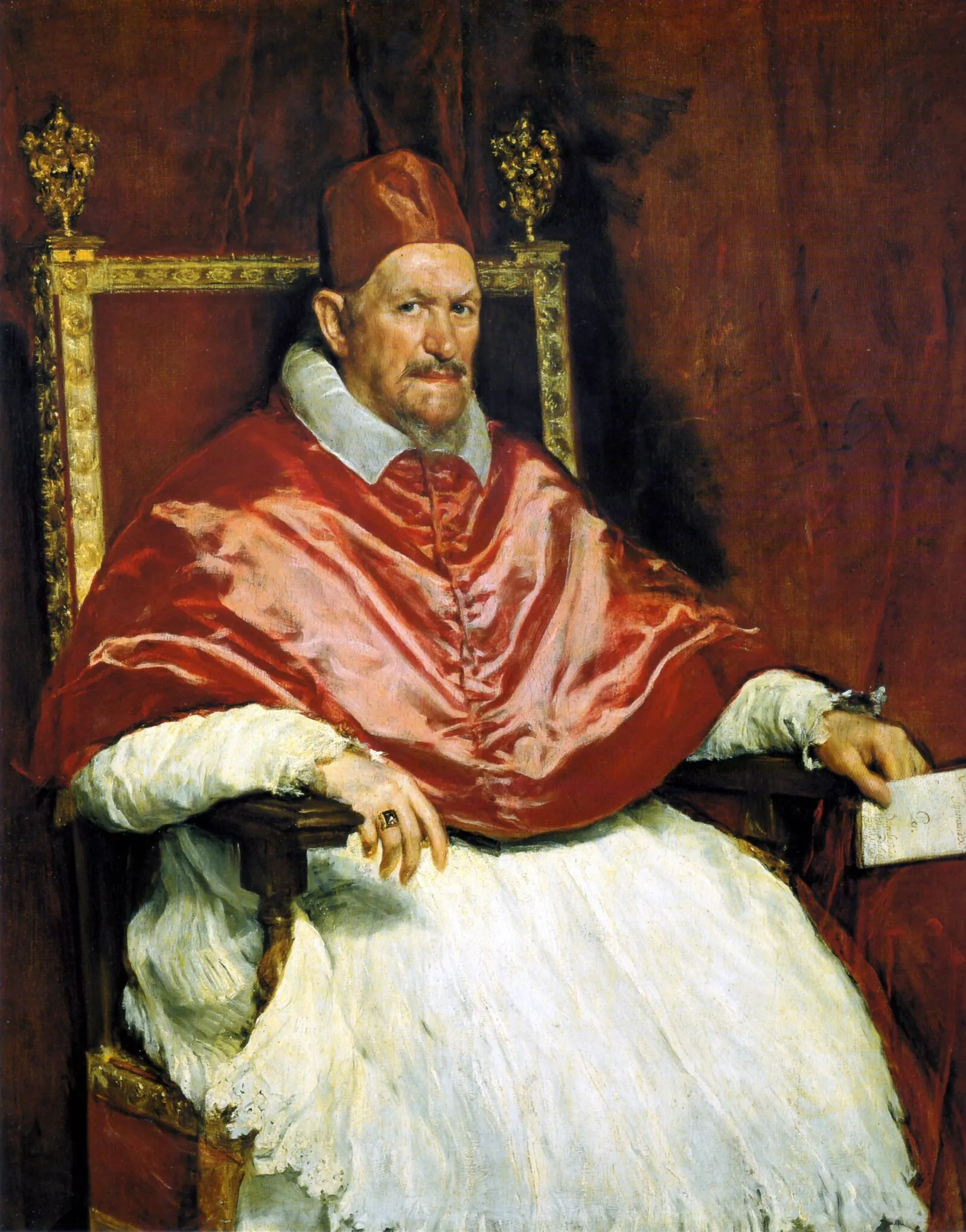
The portrait now at the Doria Pamphilj also dates from that second stay. Velázquez probably painted Innocent X Pamphilj in the summer of 1650, a dating suggested by the sitter's light linen clothing. The 75-year-old pope appears flushed and watchful, without flattering treatment.
A centuries-old Roman anecdote holds that Innocent X thought the likeness was too true to life. Historians regard the story cautiously, rather than treating the pope's reported reaction as established fact.
Francis Bacon's fascination with the painting produced more than 45 variations from the 1950s into the early 1960s, known as the screaming popes. The best-known is his 1953 Study after Velázquez's Portrait of Pope Innocent X.
In 1996, the original left Italy for the first time while Palazzo Doria Pamphilj underwent renovation. Its itinerary took it to the Prado in Madrid, then to London's National Gallery from February 22 to May 19, and to the National Gallery of Art in Washington from June 16 to December 2.
The London presentation brought the two painters' works face to face: four of Bacon's pope paintings hung opposite the Velázquez portrait. They included Head VI, from 1949, and Pope I, from 1951.
Visiting the Doria Pamphilj
The Galleria Doria Pamphilj remains a private family collection housed in a palace, with works by Caravaggio, Titian and Raphael as well as Velázquez. Admission includes an English-language audio guide.
The gallery is at Via del Corso 305, halfway between Piazza Venezia and the Pantheon. It opens from 9 a.m. to 7 p.m. on Mondays, Tuesdays and Thursdays, and from 10 a.m. to 8 p.m. Friday through Sunday. It is closed every Wednesday, and final admission is one hour before closing.
Tickets cost €16, or €17 when booked online. Children under 12 enter free, with a €1 charge for online bookings.
Velázquez e l'Italia is scheduled to open in March 2027 at Palazzo Barberini, Via delle Quattro Fontane 13.