Trains stopped before traffic was cleared to resume
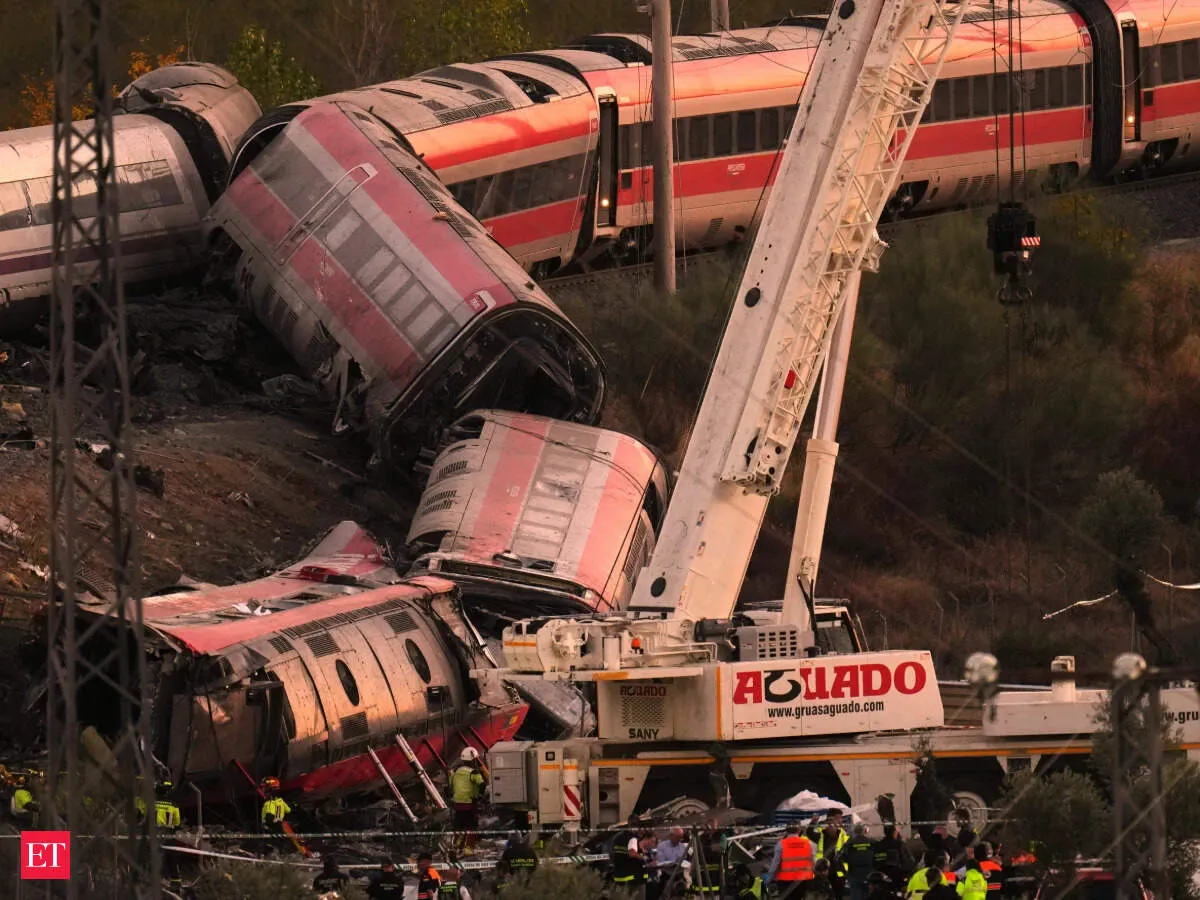
The October 28 collision took place in Castilla-La Mancha, roughly 130 km south of Madrid, on the Madrid–Seville high-speed line. The state-operated Renfe train hit the back of the Iryo service after traveling about 25 km following authorization to resume traffic.
Transport Minister Oscar Puente said the automatic control failure affected a 69-km section and brought trains to a stop. He called the circumstances in which the control center subsequently allowed traffic to restart "inexplicable," according to AFP. Investigators have not yet established the full sequence or the reasons for the collision.
Rescue teams searched the wreckage overnight, using cranes to lift damaged metal as they looked for victims, AFP reported. Survivors recounted being thrown against other passengers amid dislodged seats and scattered luggage.
Iryo is Spain's biggest private high-speed operator and ranks second overall behind Renfe, according to Ara. It began commercial operations in November 2022 and has 20 Frecciarossa 1000 trains. Italy's state railway group Trenitalia holds 51% of the company, while Spain's Air Nostrum owns 25% and Globalvia owns 24%.
How the line's train protection works
The Madrid–Seville route uses Germany's LZB, or Linienzugbeeinflussung, signaling system, El País reported. It continuously checks train speeds and sends movement instructions into the driver's cab. A failure of the automated system means operations switch to manual control.
A modernization program is replacing LZB with the European ERTMS Level 2 system. Unlike the trackside devices used by LZB, the replacement relies on radio communications, according to El País.
Spanish regulations tie permitted speeds to the protection system in use, Hindustan Times reported: the maximum is 350 km/h for ERTMS Level 2, 300 km/h for either ERTMS Level 1 or LZB, and 200 km/h for the older ASFA system. A 120 km/h limit applies when the train and track protection systems are incompatible, unavailable or not installed.
Earlier faults and an unfinished upgrade
Documents examined by TodoAlicante show that problems on the Urda section of the Madrid–Seville line predated the collision. In 2019, engineering firm Ineco warned that the aging LZB equipment might be unable to support planned upgrades.
An effort to procure a signaling upgrade began with a tender in February 2020, but that tender was canceled the following November. Adif later awarded Thales España a €93.83 million contract in September 2021 to renew signaling and install ERTMS. The Transport Ministry said in January 2026 that the rollout was continuing and LZB was still operating.
The line also experienced an LZB breakdown between La Sagra and Mora on July 12, 2025, with delays exceeding 100 minutes. On July 7, 2026, Adif reported another signaling problem, this time between Urda and Malagón, which it attributed to cable theft, TodoAlicante reported.
Separately, a parliamentary response cited by TodoAlicante recorded 162 Renfe incident reports involving delays or lost time on the Madrid–Seville line in 2025. The government acknowledged three operational safety risk notices that year. Commercial trains on the Seville–Córdoba–Madrid route operated under a 200 km/h maximum on four occasions.
A second fatal high-speed collision in 2026
The latest disaster follows a January 18 collision near Adamuz in Córdoba province, Andalusia, that killed 46 people. In that crash, a high-speed train derailed and hit an oncoming train. The investigation remains open.
Renfe chief Álvaro Fernández Heredia said only 20 seconds separated the derailment from the impact, leaving too little time for automatic braking to activate, according to Hindustan Times. A preliminary Civil Guard report issued in February identified a defect in the track, rail or weld as its leading hypothesis, while retaining seven other possible explanations.
Prime Minister Pedro Sanchez, whose government faced criticism over its response to the January disaster, announced the three-day mourning period beginning Thursday. He said two high-speed rail collisions within months were "not acceptable."
Before this year, Spain's deadliest high-speed rail accident was the 2013 derailment near Santiago de Compostela, Hindustan Times reported. An eight-carriage train derailed on a sharp curve, struck a concrete wall and caught fire; 80 people died and 145 were injured. A Transport Ministry commission found that the train was speeding and that a call from a superior had distracted the driver.
The scale of Spain's high-speed network
Spain has 3,993 km of high-speed railway, making its network Europe's largest and the world's second-largest after China's, according to International Union of Railways figures cited by Hindustan Times. Commercial high-speed services carried about 40 million passengers in 2024, a 77% increase from 2019.
Passenger deaths remain rare across European railways. Hindustan Times cited the European Union Agency for Railways' EU passenger fatality rate of about 0.019 deaths per billion passenger-kilometers traveled.