Connecting industrial production with port services
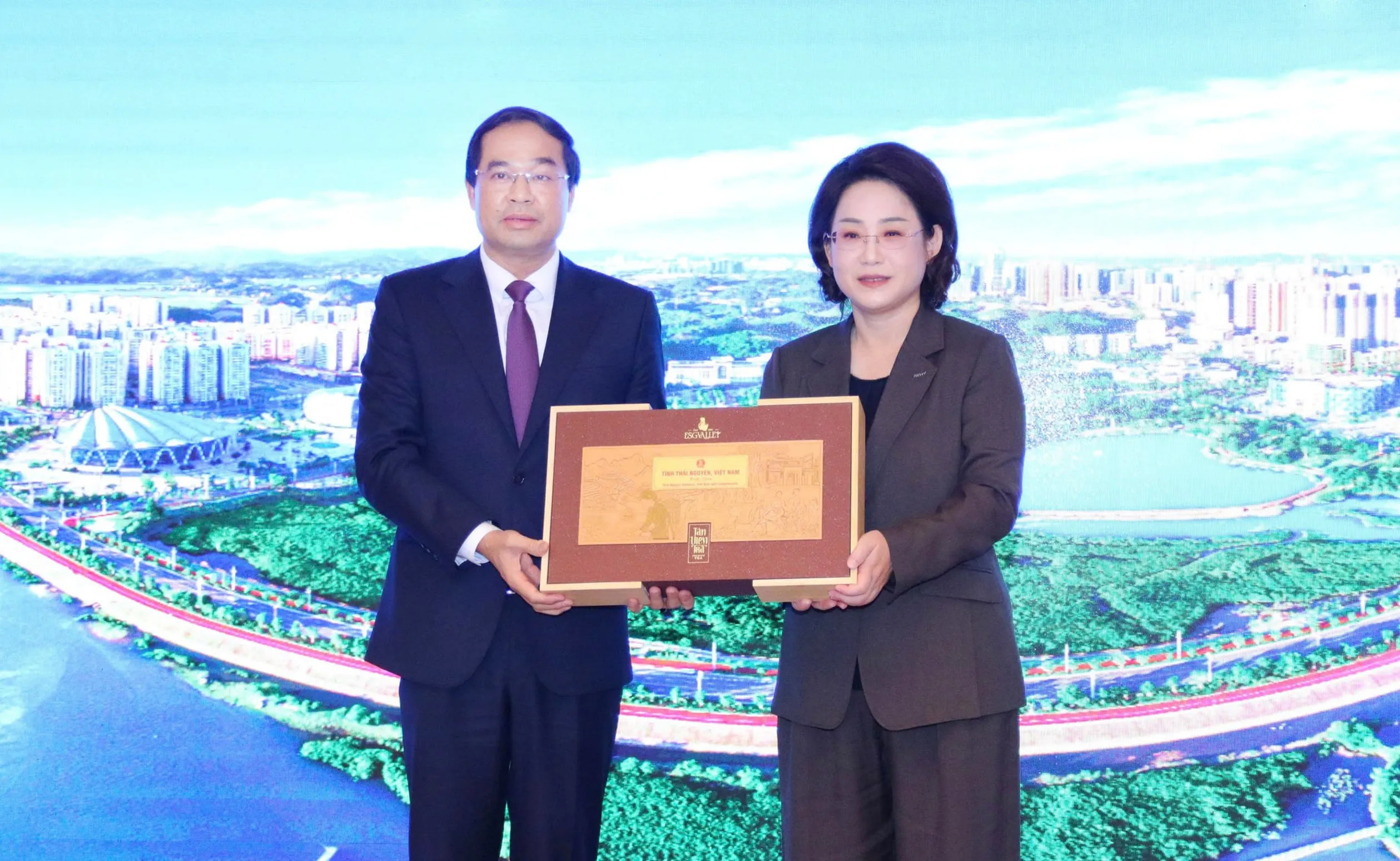
Trinh Xuan Truong, secretary of the Thai Nguyen Provincial Party Committee and a member of the Communist Party of Vietnam Central Committee, led the delegation during its working visit to Guangxi. Fangcheng Port Municipal Party Secretary Hoang Giang hosted the talks.
Truong proposed that the two localities examine infrastructure connections and supply chains that could move more goods between Vietnamese production centers and Guangxi. He praised Fangcheng Port's development of port facilities, logistics services and international transport connections.
He described Thai Nguyen as a gateway between the Hanoi Capital Region, Vietnam's northern mountainous provinces and the border with China. Its development priorities include high-tech and supporting industries, smart manufacturing, new materials, green energy and logistics, alongside digital transformation and innovation.
The discussions also covered a possible international economic corridor linking Guangxi, Cao Bang, Thai Nguyen, Hanoi, Hai Phong and Quang Ninh. Thai Nguyen is studying that corridor as it seeks broader import and export markets and new ways to organize multimodal transport and supply chains.
Both sides said stronger connections among factories, transport networks and markets could expand business opportunities, support trade and economic ties, and strengthen friendly relations between Vietnamese and Chinese localities.
The industrial base behind Thai Nguyen's proposals
Thai Nguyen's administrative merger with Bac Kan created a province covering 8,375.21 square kilometers, with about 1.8 million residents and 92 commune-level administrative units, according to Vietnam Briefing's June 2026 account.
Vietnam Briefing reported that the province had 263 active foreign direct investment projects by mid-2026, representing $11.9 billion in registered capital. Samsung Electronics Vietnam Thai Nguyen was Samsung's highest-revenue manufacturing facility in Vietnam in 2025, generating approximately $24.9 billion, a 12 percent increase from the previous year.
The province also led Vietnam in registered FDI during the first two months of 2026, ahead of Ho Chi Minh City and Bac Ninh, according to Foreign Investment Agency data cited by Vietnam Briefing. Registrations exceeded $1.65 billion, fourteen times the level a year earlier and about 27.4 percent of the national total.
At the meeting, Hoang Giang pointed to Thai Nguyen's history as a revolutionary base and its industrial development, from iron and steel to electronics. He said Fangcheng Port's industrial and marine economy offered complementary strengths. Both leaders cited historical ties as a foundation for cooperation; Hoang Giang recalled Fangcheng Port's relationship with Vietnam during the national liberation struggle.
Pier visit examines bulk-cargo and multimodal routes
On the same day, the delegation inspected Pier No. 401 in Fangcheng Port's Yuwan port area. The visit focused on possible ways to carry goods from production centers to regional markets more quickly, efficiently and at a more competitive cost.
Fangcheng Port connects southwest China with overseas markets, particularly ASEAN. Its Yuwan area handles and transships bulk commodities used in industrial production. Pier No. 401 can accommodate cargo ships of up to 200,000 DWT and is designed to handle 6.7 million tons annually, chiefly coal, iron ore and bauxite. The project's first phase is complete and operating.
Plans pair the pier with warehouses and waterway transshipment hubs to connect large seagoing vessels with river and rail services. The intended benefits are shorter transfer times, greater cargo-handling capacity and lower logistics costs. The pier has also been chosen as a connection point on the Africa-Fangcheng Port-Xinjiang international sea-rail route and connects with the Pinglu Canal.
The canal opened to navigation on September 16, 2026, following four years of construction. Built for 72.7 billion yuan, or about $10.75 billion, the 134.2-kilometer waterway connects Nanning, Guangxi's capital, to the Beibu Gulf. Chinese authorities describe it as a backbone project of the New Western Land-Sea Corridor, integrating river, rail and sea transport.
China Communications Construction Company, the project contractor, says the canal reduces inland waterway travel for southwest China by more than 560 kilometers relative to routes through Guangzhou Port and lowers overall logistics costs by 18 percent to 30 percent.
Fangcheng Port handled nearly 135 million metric tons of goods in 2025, almost 20 percent more than in 2024, according to Nanning Customs figures reported by Vietnam Briefing. Thai Nguyen's delegation used the field visit to examine potential connections between the province's factories and Guangxi's seaport network, including options for multimodal shipping and logistics cooperation.
Trade links and existing cooperation
The talks took place against a substantial cross-border trade relationship. China-Vietnam trade reached a record $296 billion in 2025, while Chinese shipments to Vietnam rose 22.4 percent from the previous year, according to China Customs data cited by Vietnam Briefing.
For Guangxi alone, trade with Vietnam totaled $35.7 billion in the first 10 months of 2025, an increase of 7.44 percent year over year, according to China Customs figures cited by Vietnam's Ministry of Industry and Trade. Guangxi exported $29.5 billion to Vietnam, up 12.13 percent, and imported $6.2 billion, down 10.5 percent. Border crossings between Vietnam and Guangxi accounted for more than 95 percent of all trade across the Vietnam-China land border.
Hoang Giang highlighted an existing collaboration beyond physical transport: a cross-border e-commerce project using artificial intelligence, signed in 2025 by Fangcheng Port businesses and Thai Nguyen University. Several of the university's member institutions are implementing it to help incubate and develop e-commerce and livestream selling. The model is intended to offer practical solutions that can be expanded and support digital economic cooperation.
He called for more information sharing, study visits and joint examination of feasible projects. Truong also identified education and training, workforce development, tea production and processing, and historical, cultural and ecological tourism as areas for cooperation. Possible activities include exchanges of experience, links between training institutions, trade and product promotion, and people-to-people programs.
Truong said Thai Nguyen would facilitate visits by Fangcheng Port businesses exploring investment, production and commercial opportunities. He also sought more opportunities for the province's companies to find partners and reach markets in Guangxi and elsewhere in China. He invited Fangcheng Port's leaders to visit Thai Nguyen to assess its potential and identify specific areas for cooperation.