From negotiations in Dayton to signature in Paris
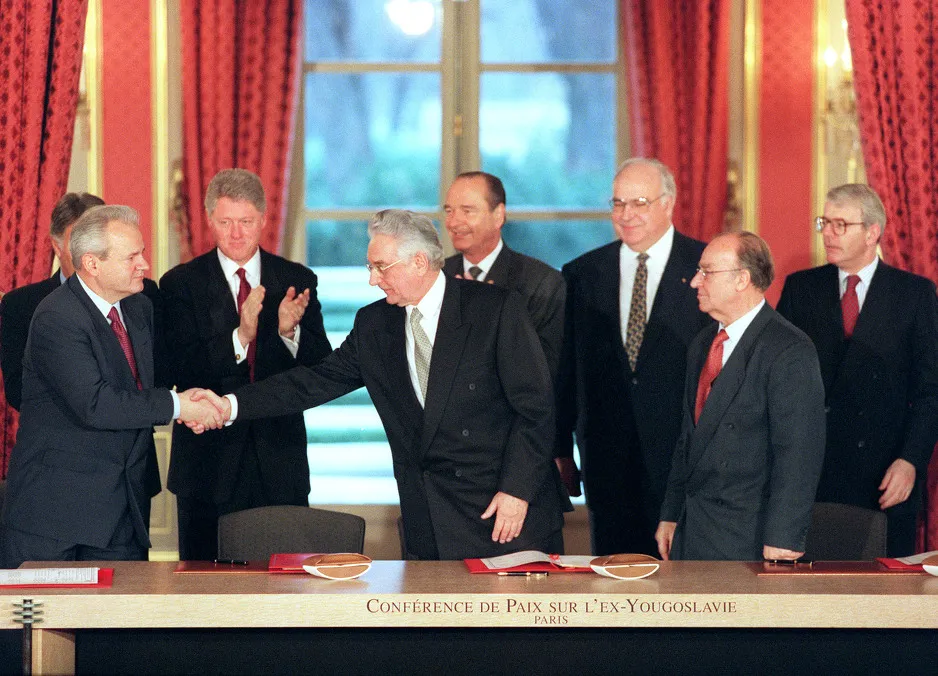
Three weeks of talks at the U.S. Wright-Patterson base in Dayton produced the General Framework Agreement for Peace in Bosnia and Herzegovina and its 12 annexes. The presidents who initialed the settlement were Serbia's Slobodan Milošević, the Republic of Bosnia and Herzegovina's Alija Izetbegović and Croatia's Franjo Tuđman.
Then-U.S. Secretary of State Warren Christopher attended the initialing. Richard Holbrooke and General Wesley Clark were the other principal American mediators.
The formal signing followed at the Elysee Palace in Paris on December 14, 1995. Republika Srpska observes November 21, the anniversary of the initialing, as a holiday and non-working day.
The constitutional and territorial settlement
Dayton established Bosnia and Herzegovina's structure as a state of three constituent peoples and others, with two entities: Republika Srpska and the Federation of Bosnia and Herzegovina. Both entities are signatories to every annex.
The country's Constitution is contained in Annex 4 and was adopted when the agreement was signed in Paris. As outlined in the U.S. Department of State's 1995 summary, it establishes a central government comprising a Presidency, a legislature with two chambers and a constitutional court. It also provides for a central bank and monetary system.
The settlement left Brčko's status to arbitration, with Annex 2 setting a one-year deadline for that determination. Today, the Brčko District in northeastern Bosnia and Herzegovina has a separate, self-governing status alongside the two entities, according to the House of Lords Library.
Military implementation and civilian oversight
The agreement addressed military implementation through Annex 1-A, which invited the NATO-led multinational Implementation Force, known as IFOR, into the country. NATO transferred responsibility for military implementation to the EU-led EUFOR in 2004. Its mission, Operation Althea, continues.
For the civilian side of the settlement, Annex 10 called for a High Representative to be designated to coordinate implementation. The Office of the High Representative can impose laws when legislative bodies fail to act and remove public officials who breach legal commitments and the Dayton Agreement.
Challenges to state authority and renewed partition calls
The House of Lords Library dates an escalation in tensions to February 2025, when Milorad Dodik was convicted of disobeying the High Representative's orders. The Republika Srpska National Assembly responded by passing legislation that rejected the jurisdiction of state-level judicial and law enforcement bodies within the entity. The High Representative characterized that action as a "hint at de facto secession".
In a May 12, 2026, assessment to the UN Security Council, outgoing High Representative Christian Schmidt called the overall security situation "stable but fragile". He also cautioned that "stability should not be mistaken for institutional health". According to the House of Lords Library, Schmidt resigned that May but will stay in office until a successor is elected.
On November 20, 2026, Helez condemned a partition proposal from Kosta Cavoski, a member of the Serbian Academy of Sciences and Arts, Anadolu Agency reported. Cavoski had proposed independence for Republika Srpska followed by union with Serbia, while Croat-majority areas would join Croatia. Helez rejected those proposals as part of longstanding efforts to undermine Bosnia's statehood.