Veterans identify gaps in burial records
The provincial and Military Region 7 steering committees responsible for finding, recovering and identifying fallen soldiers' remains convened the meeting to examine information supplied by the National Steering Committee. Participants reviewed earlier search work and compared accounts to determine where further searches should focus.
Authorities received the information about the 10 battles many years ago. Since then, local officials and military units have organized repeated surveys and excavations, drawing on the units that fought there, witnesses and longtime residents. At the conference, witnesses and representatives of the 7th and 9th Divisions' traditional liaison committees contributed documents and recollections to help narrow the search areas.
Major General Nguyen Ngoc Doanh, former deputy commander for political affairs of the 4th Army Corps, urged Tay Ninh and Military Region 7 to continue looking for 7th Division personnel killed in the Tong Le Chan area. The unit's records list 164 officers and soldiers, whose remains he asked authorities to recover so they could be returned to their comrades and families.
Differences in casualty and recovery records were another concern. Major General Nguyen Hoang, a former 9th Division commander, said the division's information lists more than 2,400 fallen soldiers and called for a detailed comparison of burial locations and numbers. At Dong Rum, for example, divisional records list about 110 fallen soldiers, whereas local information records 128 who have been found.
Checking outside information and reaching witnesses
Hoang urged caution before accepting conclusions based on foreign sources or social media. He also proposed a working group to visit surviving witnesses individually, giving particular attention to older people, those in poor health and those who have difficulty traveling.
Le Vu Minh, a former 9th Division officer, likewise called for thorough checks of sources, especially foreign organizations, before their information is used to plan a search. He described finding fallen comrades with help from two elderly residents and urged searchers to examine landscape features and old trees while seeking out people who had lived in the area for many years.
A separate case reported by Tuoi Tre News illustrates the verification work in Tay Ninh. The US organization Mission POW-MIA supplied data suggesting that 16 Vietnamese soldiers might be buried together in Tan Lap hamlet, Ben Cau commune. At a September 16, 2026 workshop, provincial authorities checked that information against the combat history of the 429th Special Forces Brigade and found grounds to believe that a mass grave there may remain unexcavated.
In his closing instructions at the November 25 conference, Major General Pham Anh Tuan, head of political affairs and deputy head of the standing committee of Military Region 7's steering committee, called for accurate burial locations and lists of the fallen, with discrepancies resolved. Military Region 7 and provincial authorities should address matters within their powers and refer those beyond their authority to the National Steering Committee for consideration and support.
Tuan directed the military region's staff to compile the conference's recommendations. He also asked the Tay Ninh Provincial Military Command to continue advising the provincial steering committee on forming a group to visit elderly and frail witnesses. The provincial committee was instructed to work more closely with units that took part in the fighting, veterans' liaison committees and residents to strengthen the database and identify areas where the evidence supports further searches and repatriation.
Search operations in Tay Ninh and Cambodia
Tay Ninh housed the resistance movement's leadership bodies after being selected by the Central Committee for its strategic importance. It was a battlefield during the wars against France and the United States and during the border war. Tens of thousands of Vietnamese cadres, soldiers, volunteers and experts fought and died there.
A May 30, 2025 site assessment listed an initial total of 21,914 fallen soldiers buried in the province. It separately recorded 4,320 local personnel and 17,954 from other units. Authorities have recovered the remains of 15,479 fallen soldiers.
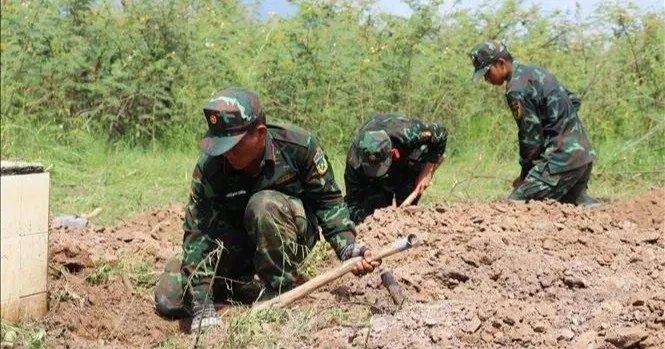
From the start of the "500-Day Campaign to Intensify the Search, Collection, and Identification of Martyrs' Remains" through November 20, 2026, Tay Ninh units completed 36 survey and excavation operations at 30 locations. Work covered roughly 40,000 square meters and involved removing more than 60,000 cubic meters of soil and rock. The operations recovered 19 sets of remains.
In eight Cambodian provinces, the K70, K71 and K73 search teams deployed 382 officers and soldiers for three operations totaling 204 days. They excavated and leveled 379 locations, moved more than 37,350 cubic meters of soil and rock, and recovered 816 sets of remains.
Vietnam News reported that Tay Ninh held an August 21, 2026 send-off for the three teams for their 26th search phase in Cambodia. For that phase, they have 143 information sources pointing to possible burial locations for 440 fallen soldiers across eight localities. Their missions are scheduled to continue until June 30, 2027.
DNA sampling and national recovery figures
Alongside the searches, Tay Ninh has completed DNA sample collection at all 18 of its cemeteries for fallen soldiers, according to Vietnam News. Teams sampled 18,593 unidentified graves; 15,336, or 82.48%, met the requirements and yielded DNA samples.
Provincial police also collected more than 5,751 DNA samples from relatives of over 4,000 unidentified fallen soldiers during a July 5-11, 2026 peak collection period. That work reached all 96 communes and wards in the province.
National Steering Committee figures put recoveries under the nationwide 500-Day Campaign at 1,425 sets of remains as of July 27, 2026. Of those, 401 were recovered in Vietnam, 174 in Laos and 850 in Cambodia.
By late July, the nationwide effort had collected 93,464 biological samples from relatives. Of these, 53,036 had been analyzed and synchronized into the DNA matching database. Sampling work on remains had covered 66,013 graves, with 46,116, nearly 70%, meeting the sampling criteria.
On November 25, Deputy Prime Minister Pham Thi Thanh Tra, who heads the National Steering Committee, ordered completion and operation of the Military Forensic Institute's new DNA testing system before December 15, 2026. The institute is part of a Vingroup Corporation-sponsored system spanning four testing facilities, with cleanrooms, next-generation sequencing equipment, bioinformatics software and microarray chips.