Calm reported along the front
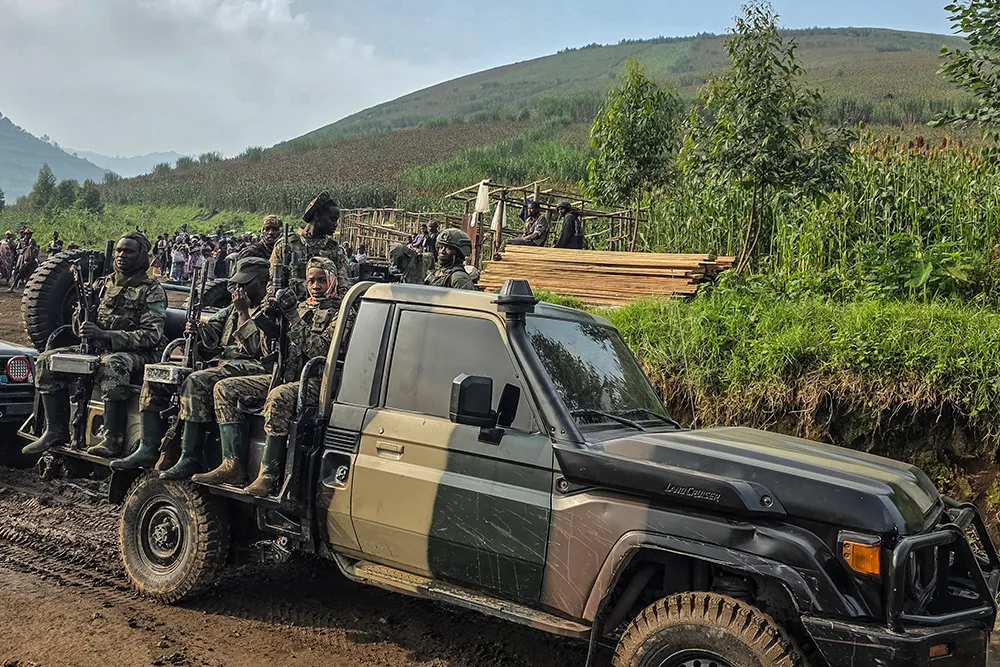
At Minembwe in South Kivu, local and security sources reported a quiet front line on February 19 after M23 fighters left their positions. An anonymous local official told AFP: "But we don't know if this amounts to a withdrawal." Security sources reported similar conditions elsewhere along the front.
Angola had proposed a ceasefire to the DRC and Rwanda beginning February 18. Kinshasa accepted it "in principle" but did not confirm the start date. Since M23 reemerged in 2021, six ceasefires and truces have been agreed to and subsequently broken.
Angola's initiative and M23's rejection
The research group IPIS dated Angolan President João Lourenço's proposal to February 11. It followed a February 9 meeting he hosted in Angola with DRC President Félix Tshisekedi, Rwandan President Paul Kagame and African Union mediators Faure Gnassingbé, the Togolese president, and Olusegun Obasanjo, Nigeria's former head of state. M23 did not participate, according to the Critical Threats Project.
AFC/M23 described the initiative as a "diplomatic fragmentation strategy" and maintained that it was committed to the separate Doha process, IPIS reported. M23 also accused the Congolese government of "delaying tactics and attempts at manipulation" to avoid serious efforts to resolve the conflict.
On February 16, M23 deputy spokesman Oscar Balinda reiterated that the group did not recognize the Angolan proposal in comments to the Rwandan outlet The New Times, according to the Critical Threats Project.
The Doha negotiations had produced a framework agreement between the Congolese government and AFC/M23 in November 2025. By early 2026, however, the parties had signed only two of its eight implementation protocols, IPIS said. They agreed on February 2 to terms of reference for the Ceasefire Oversight Verification Mechanism (COVM).
Preparations for monitoring also included a February 12-13 visit to M23-controlled Goma by the acting head of the UN peacekeeping mission in the DRC, the Critical Threats Project reported.
Territorial gains and US pressure
Eastern Congo, which borders Uganda, Rwanda and Burundi, has been a conflict zone since 2021. During an offensive in early 2025, M23 captured Goma, Bukavu and extensive territory.
The group took Uvira in December 2025, just days after Rwanda and the DRC signed the US-brokered Washington peace agreement. The seizure drew an angry US response. M23 withdrew under US pressure in mid-January 2026, and the Congolese army, known as FARDC, did not regain full control until January 18, according to IPIS.
Washington continued to criticize M23 and Rwanda in February. The Critical Threats Project reported that Massad Boulos, President Donald Trump's Africa adviser, blamed them for recent violence in eastern Congo. On February 16, he called Rwanda's backing for M23 a "serious breach" of the Washington framework; the following day, he warned that "any party" undermining peace efforts could face sanctions.
Uvira's aftermath
Following the AFC/M23 withdrawal, several mass graves were discovered in Uvira and nearby areas, containing more than 150 civilian bodies, IPIS reported. A Congolese government report issued in April 2026 said the five-week occupation had forced more than 300,000 people to flee, left more than 1,500 people dead and involved the rape of 14,400 women, according to IPIS.
Fighting in the Ruzizi Plain also prompted Burundi to close its border with the DRC for two months beginning December 10, 2025. IPIS said trade across that border accounts for about 50% of South Kivu's economy.
The Kavimvira crossing reopened on February 23, 2026. Many of the estimated 90,000 Congolese who had fled to Burundi subsequently returned home, according to IPIS.