The woman entrusted with Romans
In Romans 16:1-2, Paul writes: "I commend to you Phoebe, our sister, who is a servant of the assembly that is at Cenchreae, that you receive her in the Lord, in a way worthy of the saints ... for she herself also has been a helper of many, and of my own self."
Delivering the letter, dated to about AD 57, likely involved more than transporting it. As its presumed bearer, Phoebe would probably also have read it to the congregations in Rome and explained Paul's intentions.
The terms Paul uses for Phoebe remain a subject of scholarly discussion. In a 2019 article in In die Skriflig, Robin Gallaher Branch examines three designations: adelphe, meaning sister; diakonos, translated as deacon, minister or servant; and prostatis, rendered as patron, benefactor or helper. Prostatis appears nowhere else in the New Testament. Scholars debate whether diakonos in this passage identifies a church office or a letter-carrier role.
Corinth's eastern gateway
Cenchreae, also known as Kenchreai, was about 10 kilometers (6 miles) east of Corinth on the Saronic Gulf. Its trade routes extended east toward Asia Minor and the Levant. Acts 18:18 also places Paul at the port, sailing from it during his second missionary journey.
The inland city-state of Corinth had two ports with different trading connections. As described in Wikipedia's Kechries entry, Kenchreai handled eastern routes through the Saronic Gulf, while Lechaion, on the Corinthian Gulf, connected Corinth with Italy and the rest of Europe to the west.
The harbor also had several religious sites. In Description of Greece II, 2, 3, the second-century AD geographer Pausanias describes a temple and stone statue of Aphrodite, along with a bronze Poseidon on a mole extending into the sea. He places sanctuaries of Asclepius and Isis at the harbor's opposite end.
Glass cargo beneath the water
Earthquakes in the late fourth century AD, around AD 365 and 375, lowered the coastline and left much of the ancient harbor underwater. Excavators later identified stone piers, warehouses and other port buildings among the submerged remains.
The University of Chicago and Indiana University excavated the site from 1963 to 1968. The American School of Classical Studies at Athens records that Robert L. Scranton of Chicago directed the project under the School's Corinth permit, with Indiana's Edwin Ramage joining as co-director in 1964.
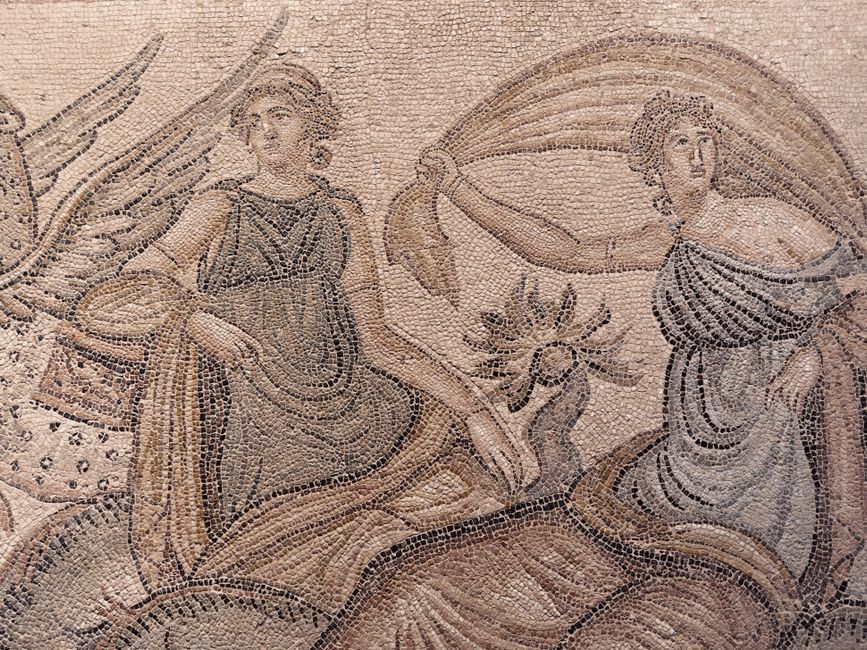
One discovery preserved cargo that had never been unpacked for installation: more than 100 glass opus sectile panels, dating to about AD 370, remained in wooden shipping crates protected by mud. Opus sectile uses cut pieces of glass to form images in a mosaic-like technique.
According to the American School's history, the panels were recovered in 1965 from a sanctuary's apsidal cult room. The building may have been a sanctuary of Isis. Made from thin, opaque glass, the panels depict harbor and architectural scenes, Nile landscapes and human figures. Wood and marble found in an adjoining room indicate that construction there was never finished.
A later church and continuing excavations
At the harbor's southern end, the foundations of a fourth- or fifth-century Christian basilica lie directly over earlier Roman port structures. The church dates from centuries after Phoebe's life, showing that a Christian community remained at Cenchreae long after her time.
Research has also extended beyond the waterfront. Since 2002, surveys and excavations jointly sponsored by the American School of Classical Studies at Athens and the Greek Ministry of Culture have examined Koutsongila, the low ridge immediately north of the harbor. Their work has focused on a large cemetery containing Early Roman chamber tombs and Roman to Early Byzantine cist graves, a lavish residential quarter facing the sea, and other substantial buildings overlooking the port.
Joseph L. Rife now directs the American Excavations at Kenchreai. His team is reassessing the material discovered in the 1960s and working to finish its study and publication.