Longer service and higher payments
The Cabinet, chaired by Prime Minister Narendra Modi, approved a "Second Tour of Duty" for the 75% of each batch not selected for regular service after four years. The additional two years bring their total engagement to six years. Chief of Defence Staff General N.S. Raja Subramani announced the decision.
The revised terms provide that, after six years, all willing Agniveers who meet objective selection criteria can be enrolled as regular soldiers. Defense officials told NDTV that the extension covers only the nine existing batches; rules for future recruits will be reviewed later.
Pay during the extension will rise to Rs 43,500 in the first additional year and Rs 47,500 in the second. The first batch's starting pay was Rs 30,000. For those leaving after their engagement, the government will fund 70% of an enhanced Seva Nidhi exit package, replacing the previous equal split between the government and the recruit.
The Wire reported that retained Agniveers would face another 25%-75% retention split in 2029, when the first batch completes six years, and that those not retained would receive no reservation benefits in government jobs. In his November 7 column in ThePrint, Shekhar Gupta noted that the six-year endpoint would fall on the eve of the 2029 general election.
Who is approaching the end of service
The first Navy batch reaches the end of its original four-year term in November 2026, with the first Army and Air Force batches following at the end of December. According to The Indian Express, more than 300,000 Agniveers are at various stages of training across the three services. About 280,000 are in the Army, including roughly 19,000 approaching completion of their initial four-year tenure.
Introduced on June 14, 2022, Agnipath replaced a recruitment system that offered soldiers 15-year terms and guaranteed pensions. The shorter service period and the substitution of a lump-sum Seva Nidhi payment for pensions prompted widespread protests, especially in northern states.
The electoral stakes
Gupta, who supported Agnipath, described the revision as a rollback driven by electoral caution. Under the original arrangement, 75% of the first intake would have returned to civilian life by December, shortly before February elections in Uttar Pradesh, Uttarakhand, Punjab and Manipur. All four states have traditionally supplied substantial numbers of military recruits.
In Gupta's assessment, the BJP was unwilling to risk the political reaction to those soldiers returning home, particularly in Uttar Pradesh and Uttarakhand. He also pointed to elections expected around November 2027 in Gujarat and Himachal Pradesh. The latter, which the BJP lost to Congress in the previous election, has a large constituency of former service members.
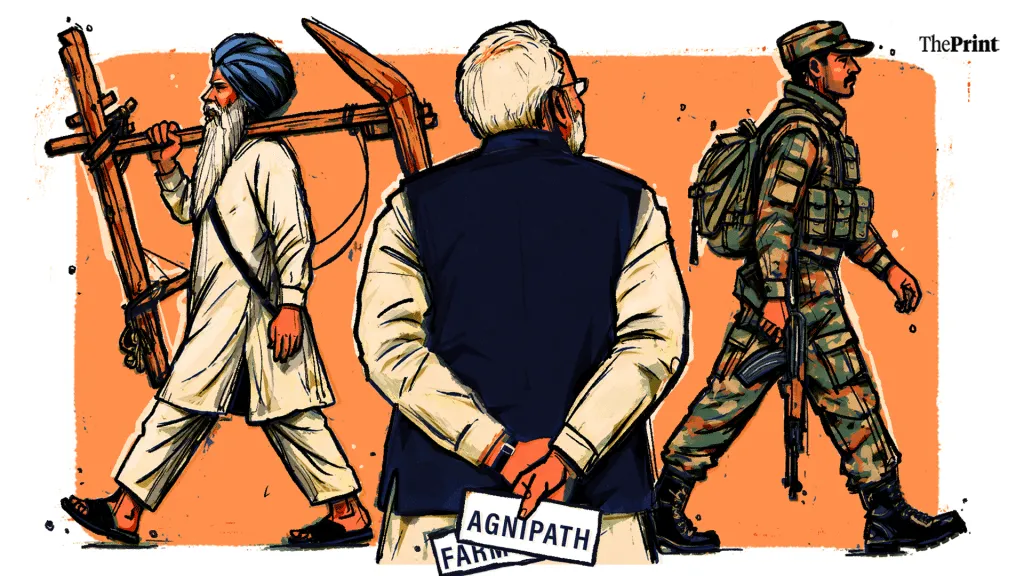
He compared the Agnipath reversal with the farm laws enacted in 2020 and repealed in full in 2021 after farmers' opposition. He also cited the government's reversal on a caste census and its embrace of cash transfers and other benefits despite Modi's criticism of "revdi" culture.
Gupta's broader argument was that the government had taken two loyal constituencies—Hindi-heartland farmers and soldiers—for granted, failing both sides of the "Jai Jawan/Jai Kisan" sentiment. He noted that his column had supported the policy ideas he was discussing.
Questions about planning and implementation
Gupta attributed the resistance to inadequate consultation and preparation before changes with lasting consequences for those affected. He argued that a substantial rehabilitation program, starting halfway through the four-year term, could have eased the transition out of military service. The proximity of the first departures to state elections, he wrote, had been foreseeable from the outset.
He also criticized the creation of separate categories within military units: Agniveers and career soldiers had different pay arrangements and different benefits for their families in the event of a combat death. He regarded the resulting Agniveer sub-units as unsustainable.
The reform's objectives—lowering future pension costs and reducing the armed forces' average age from 32 to a range of 24 to 26—remained worthwhile in his view. But he argued that inadequate planning, rushed implementation and the subsequent retreat had undermined both aims, making the reform politically difficult to salvage.
Congress and a retired officer challenge the changes
Congress called for Agnipath to be scrapped on November 6, saying it had "weakened" India's security. The party also demanded that the 25% selected for regular service receive all regular-soldier benefits retroactively from their recruitment date.
Colonel Rohit Chaudhry, the retired officer who heads Congress's ex-servicemen department, also claimed that more than 40 Agniveers had died by suicide.
Retired Lt. Col. N. Thiagarajan questioned whether the extension resolved the scheme's underlying problems. Quoted by The Wire, he said it "does not address its fundamental flaws" and "risks undermining national security, operational readiness, combat experience and the long term career aspirations of our soldiers."