Why the prosecution was quashed
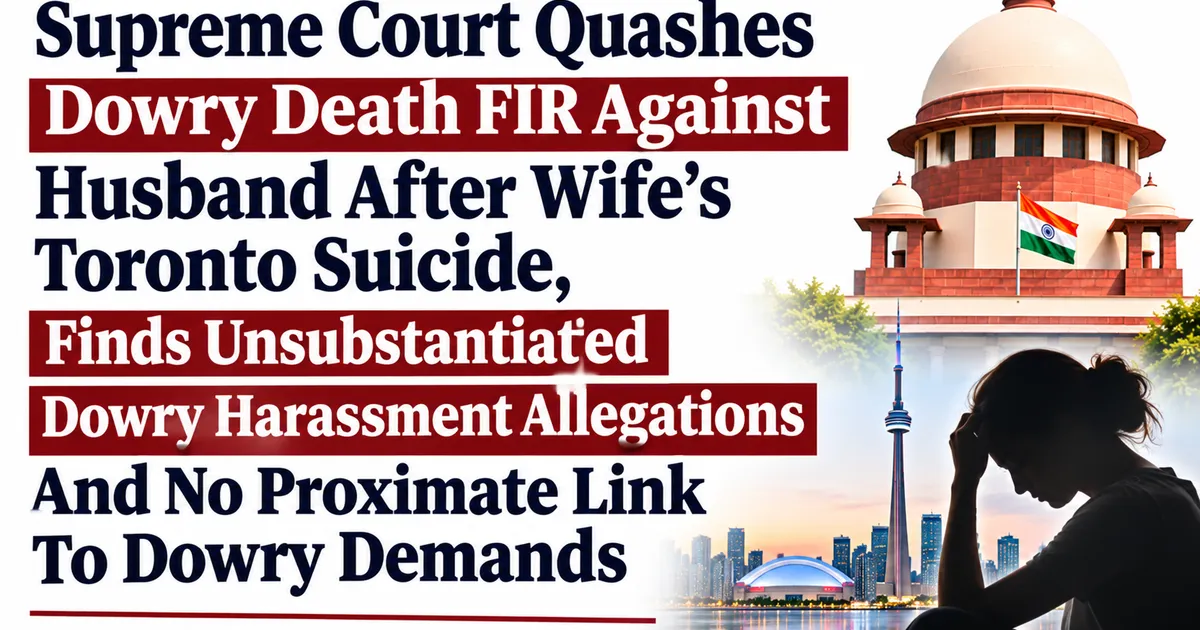
Justices B.V. Nagarathna and Manmohan allowed Narlawar's appeal in Piyush s/o Deepak Narlawar v. State of Maharashtra & Ors., 2026 INSC 1183. They overturned the Bombay High Court's refusal to grant him relief and quashed FIR No. 212/2023, along with the criminal proceedings arising from it.
The central question was whether the material supported the offenses alleged, including dowry death under Section 304-B of the Indian Penal Code. That provision requires an unnatural death within seven years of marriage and dowry-related cruelty or harassment soon before death. The presumption under Section 113-B of the Evidence Act arises only after those foundational facts are established.
The Court found no contemporaneous complaints or specific incidents establishing the required connection between a dowry demand and the suicide. It also concluded that the unsupported accounts of scolding, abusive language, harassment and hurt did not satisfy the separate requirements for cruelty, voluntarily causing hurt or intentional insult likely to provoke a breach of peace.
The death and the Canadian investigation
Narlawar and the complainant's daughter married on January 3, 2021, and relocated from Chandrapur to Toronto in February 2022. She died on June 11, 2023, after falling from their apartment on the 22nd floor.
Investigators recovered a handwritten suicide note from the apartment. It read: "I Failed in my life. It's been more than a year but still struggling to find a job. I feel like I am Stupid and useless person. I don't want to live with this feeling, so I quit. I don't want to live so I am leaving. Just donate my all organs to the needy people and bury me here, its my last wish."
The note made no accusation against her husband. A coroner's investigation statement and post-mortem report issued by the Ministry of Solicitor General of Canada on October 12, 2023, identified multiple blunt impact trauma from a fall as the cause of death. The records noted stress over her studies and difficulty finding suitable work, as well as no prior medical history or prescription medication use.
Toronto police closed their investigation in a report filed on January 8, 2024. They had verified that the note was in her handwriting and found no evidence of a struggle or scuffle inside the apartment. The Canadian investigation found no foul play, and CCTV footage showed that Narlawar was absent when she fell.
Disputed gifts and financial transfers
The wife's father alleged demands involving 15 tolas of gold, later jewelry gifts and a transfer of ₹1 lakh from her brother. He also accused Narlawar of withholding devices and records, and argued that the Canadian police had not investigated the Indian offense of dowry death. The State maintained that its investigation had uncovered mental and physical violence and questionable transactions, requiring custodial questioning of Narlawar and examination of electronic material.
The father also told the Supreme Court that his daughter had video-called her mother hours before her death. According to his account, she wore a new dress, discussed attending a social function and showed no sign of mental turmoil.
Narlawar disputed any coercive demand. He characterized the allegations as vague, retrospective and unsupported, citing the suicide note and Canadian findings. He said the jewelry consisted of customary marriage and festival gifts, pointed to transfers between family accounts and noted that his wife was a nominee for his investments.
In examining the ₹1 lakh transfer, the Court noted that it occurred around the time Narlawar booked his wife's flights from Canada to India. His bank statement also reflected multiple transactions involving his and his wife's accounts. The justices rejected treating that single transfer, isolated from its context, as incriminating.
The Court found that the transactions did not establish a dowry demand. Likewise, the exchange of jewelry at the wedding and Diwali did not automatically turn customary gifts into dowry.
The complaint and the appeal
The father registered FIR No. 212/2023 on June 30, 2023, at Satara Police Station in District Aurangabad Town, Maharashtra. It alleged dowry death, cruelty, hurt and intentional insult under IPC Sections 304-B, 323, 498-A and 504, read with Section 34, as well as offenses under Sections 3 and 4 of the Dowry Prohibition Act.
As LiveLaw reported, the four substantive IPC provisions correspond to Sections 80, 115(2), 85 and 352 of the Bharatiya Nyaya Sanhita, 2023.
On January 8, 2025, the Bombay High Court's Aurangabad Bench decided Criminal Application No. 725/2024. It ended the case against Narlawar's parents and sister but left the proceedings against him intact.
A chargesheet followed, and the trial court issued non-bailable warrants against Narlawar on February 4, 2025. The Supreme Court issued notice in his appeal on August 11, 2025, and barred coercive steps against him on the condition that he cooperate with future investigative and judicial proceedings.
The ruling's legal limits
The Supreme Court found that the accusations of cruelty, mental harassment and voluntarily causing hurt were made "not with a bona fide intent as they are vague and general in nature." It applied sub-paragraphs (1), (2), (3), (5) and (7) of paragraph 102 of State of Haryana v. Bhajan Lal, which identifies circumstances in which criminal proceedings may be quashed, including allegations that disclose no offense, inherently improbable accusations and malicious proceedings.
The justices concluded that allowing this prosecution to continue would abuse the criminal process. Their decision rested on the particular documentary record and the missing elements of the charged offenses, not on a rule that a spouse's suicide or the absence of an earlier police complaint necessarily defeats a dowry-related prosecution. Cases supported by specific, legally sufficient allegations and evidence remain distinct.