What the valuations imply
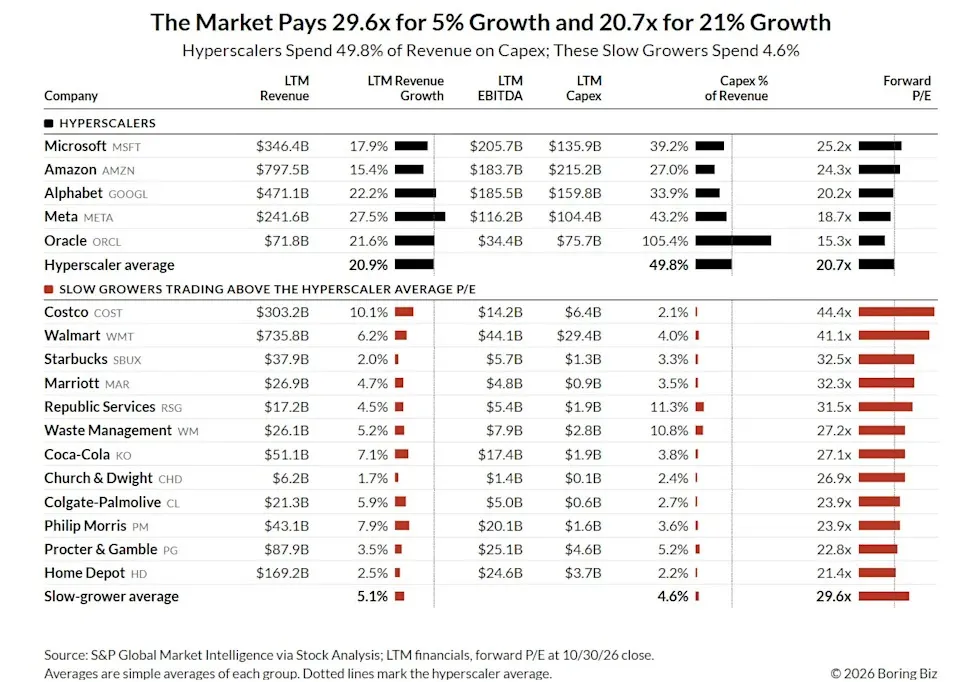
AI spending worries helped wipe more than $1 trillion from Nasdaq 100 companies' market value on a Friday in late October. The Nasdaq composite dropped 2.9%, while the S&P 500 lost 1.8%. An S&P Global Market Intelligence analysis cited by AInvest found that Costco and Walmart traded at roughly 44 and 41 times forward earnings, respectively, above the multiples of Microsoft, Amazon, Alphabet, Meta and Oracle.
AInvest's argument rests on the gap between valuations based on past earnings and those based on forecasts. Its Nov. 2 data showed Alphabet trading at about 14.6 times trailing earnings versus 27.4 times forward earnings. Amazon's corresponding multiples were 19.3 and 36.8; Microsoft's were 27.2 and 38.1.
At the same share price, a higher forward multiple implies a smaller expected earnings denominator. AInvest interprets those figures as forecasts for next-12-month profits roughly half their trailing level at Alphabet and Amazon, and about 29% lower at Microsoft. In that reading, the apparently low trailing valuations reflect expectations of deteriorating profits rather than an uncomplicated discount.
Cash generation cannot keep up with construction
The spending surge is already visible in cash flow. Citing The Kobeissi Letter, AInvest reported that Amazon, Alphabet, Meta and Microsoft invested a record $201.9 billion in capital expenditures in the third quarter of 2026, more than twice the year-earlier amount. Together, they recorded a quarterly free-cash-flow deficit of $26.4 billion, their largest ever.
Silicon Report's company-level figures show Alphabet with a $9.1 billion free-cash-flow deficit in the September quarter, its second consecutive negative quarter. Meta's deficit was $2.1 billion, its first negative free cash flow since 2012. Microsoft alone remained positive, generating $18.6 billion. Amazon's trailing free cash flow, meanwhile, shifted from a $14.8 billion inflow a year earlier to a $42.4 billion outflow.
The longer-period figures show spending outpacing growth in cash from operations. Across the first nine months of 2026, Microsoft, Alphabet, Amazon, Meta and Oracle generated a record $542.9 billion in operating cash flow, up 29% year over year, according to Silicon Report. Capital spending doubled to $556.9 billion. That left a $14 billion free-cash-flow deficit, compared with a $143.5 billion surplus a year earlier.
Share repurchases across those five companies fell 83% to $13.6 billion, with Alphabet and Meta buying back no shares in 2026, Silicon Report said. Looking ahead, Evercore ISI strategist Julian Emanuel projected that the cohort was heading toward a combined free-cash-flow deficit approaching $200 billion over the next 12 months.
Spending totals and accounting choices
AInvest put this year's data-center investment at $828 billion, including guidance of about $220 billion from Amazon, up to $205 billion from Alphabet and roughly $170 billion from Microsoft. Its counterargument to the bearish view is that this cash buys assets intended to produce revenue, rather than representing an immediate loss.
The analysis contends that investors risk penalizing the same investment twice: first for the cash used to build infrastructure, then for depreciation that reduces future reported earnings, without assigning sufficient value to the assets' revenue potential. That argument depends on the infrastructure earning more over its useful life than it costs.
Microsoft illustrates why a lower headline capex number does not necessarily mean a retreat from construction. CNBC reported on Oct. 29 that the company reduced its calendar-2026 forecast from $175 billion to about $170 billion. CFO Amy Hood attributed the shortfall to delays among third-party GPU and data-center capacity providers, pushing some capacity availability into the first half of 2027. She expects spending to accelerate during that period because of delayed deliveries and higher component costs.
A separate accounting change also reduced Microsoft's reported capex figure, according to Market Analysis. In July 2026, the company extended the assumed useful life of its buildings from 15 years to 25 years. Future data-center leases consequently moved from finance-lease to operating-lease treatment, taking them out of the capex line. Before that change, Microsoft's calendar-2026 plan was about $190 billion.
Strong cloud growth, weaker order signals
Current cloud revenue provides evidence in favor of the buildout. Azure's July-to-September growth reached 48% in constant currency, above Microsoft's 44%-45% forecast; AInvest described it as the fifth consecutive quarterly beat. AWS revenue grew 39%, exceeding consensus, and Amazon forecast growth above 40% in both 2027 and 2028.
Combined cloud revenue growth at the three largest providers accelerated to 56%, according to the analysis. Citi raised its AI-service revenue estimates for 2026 through 2028 on the strength of cloud monetization.
Forward-looking demand measures were less encouraging. Microsoft's commercial bookings declined 11% in constant currency, and combined hyperscaler backlog additions fell to $128 billion from $237 billion in the preceding quarter. Emanuel described the free-cash-flow deterioration as "structural rather than cyclical."
The longer-term revenue requirement is also substantial. Fortune reported Gartner's estimate that data-center owners need $8.5 trillion in cumulative revenue by the end of the decade to justify their investments. Expected enterprise and consumer AI revenue from those data centers would total no more than $3.6 trillion by then.
External financing and credit pressure
The buildout is drawing heavily on capital markets. AInvest reported $182 billion in U.S. senior-note issuance by the sector this year, compared with $93 billion last year. Fortune reported that in late October Microsoft raised $25 billion in debt, Meta announced plans for up to $95 billion in equity financing, and SpaceX closed $40 billion in debt financing.
Meta also faced a credit warning. S&P Global changed its outlook on the company from "stable" to "negative" in late October, citing negative cash flow and uncertainty over capital expenditure plans, according to Fortune.
Funding ambitions have narrowed elsewhere in AI. Fortune, citing Financial Times and Wall Street Journal reporting, said OpenAI lowered the target for its latest funding round from $30 billion to $20 billion after obtaining about $11 billion in commitments, less than half the original goal.
Oracle has outlined limits on further financing alongside a path back to positive cash flow. After spending $55.7 billion on data centers, it reported negative free cash flow of $23.7 billion for fiscal 2026. At its Oct. 28, 2026 Investor Day, Oracle capped new financing through fiscal 2030 at $20 billion, split between $10 billion in equity and $10 billion in gross debt.
Oracle forecast that free cash flow would turn positive in the second half of fiscal 2028 and reach at least $30 billion in fiscal 2029. Its shares rose about 11% following the announcement, according to Yahoo Finance and 24/7 Wall St.
The test for 2027 spending plans
Investors are pressing hyperscaler management teams to reduce 2027 capital spending. AInvest argues that a plateau in construction could eventually slow depreciation growth while completed infrastructure continues to generate revenue, allowing earnings forecasts to recover. Microsoft's expected spending acceleration in the first half of 2027, however, shows that a lower 2026 figure need not signal a lasting slowdown.
The central test in AInvest's analysis is whether cloud and AI revenue growth catches up with capital spending. If earnings estimates continue to fall while investment rises and cloud growth slows, the pessimistic valuations would be supported. If profits recover as spending peaks, the large gap between forward and trailing multiples could narrow.