Factory assembly shifts work off-site
The release, published by Salt Lake City Headlines, describes a shift away from distribution stations requiring months of construction, including buildings, trenches, fencing and equipment assembly. A box substation arrives with its transformer, switchgear, protection, controls and auxiliary equipment already installed, wired and checked. After placement and feeder connections, the release says, it can be energized in days rather than months.
Utilities, engineering, procurement and construction contractors, industrial plants and export buyers use several versions of the design. Compact units serve space-constrained sites; containerized stations accommodate shipping and larger projects; skid-mounted and mobile stations can move between temporary or emergency assignments.
The claimed benefit goes beyond installation speed. Factory engineering establishes equipment clearances, cable routes, cooling arrangements and protection coordination before delivery. The release attributes more consistent performance to that controlled process, while enclosed designs can address noise, weather exposure and corrosion.
Demand grows alongside grid investment
Growth Market Reports estimates that the worldwide prefabricated substation market was worth $8.8 billion in 2025. The research firm forecasts $17.8 billion by 2034, representing an 8.2% compound annual growth rate for 2026–2034. It identifies urbanization, renewable energy construction and grid modernization spending as growth drivers.
Asia Pacific represented approximately 38.5% of the market in 2025, or about $3.4 billion, according to the firm. Its projected annual growth rate of 9.1% through 2034 is the highest among regions, supported by grid expansion and renewable energy programs in China, India and Southeast Asia.
Broader electricity forecasts provide context for that demand. In November 2026, the International Energy Agency warned that annual global data center electricity consumption could reach about 1,000 terawatt-hours by 2030, double its current level, under the agency's Stated Policies Scenario. CNBC's coverage of the World Energy Outlook 2026 also reported a projected 75% increase in grid spending over the next decade under the separate Current Policies Scenario. The IEA described power networks as one of the decade's biggest energy investment stories.
The agency projects a 40% to 50% rise in peak electricity demand by 2035. It says grids should add 26 million kilometers of lines by then, alongside replacement or refurbishment of about 16 million kilometers of existing lines. Copper, cable and transformer supplies are already tight, the IEA notes.
Matching the equipment to the site
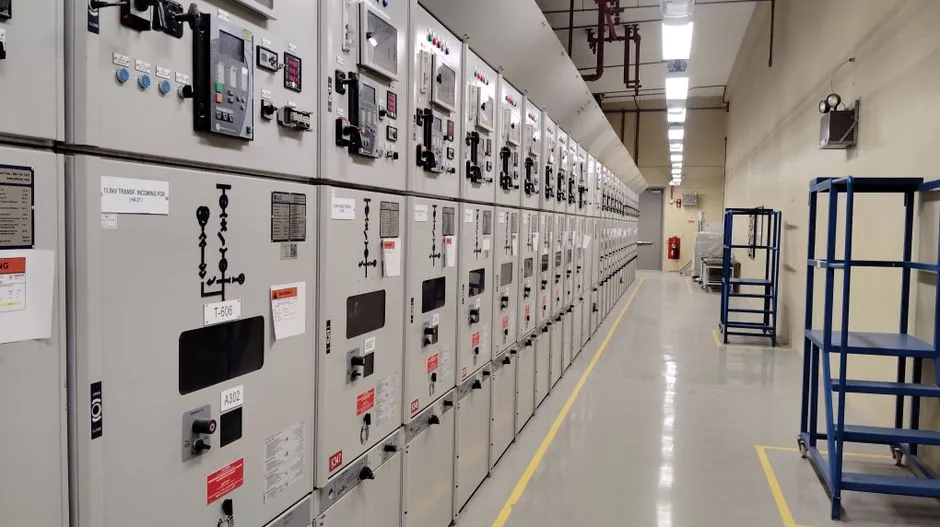
Inside a typical enclosure, an oil-immersed or dry-type distribution transformer works with medium-voltage switchgear and ring main unit equipment. Low-voltage panels supply outgoing feeders, while metering, protection and automation equipment manage operation. Supporting systems include ventilation, heating, lighting, surge protection and safety interlocks.
Transformer selection shapes the rest of the station. The release describes oil-immersed designs as the dominant choice because they combine high capacity, low cost and established reliability. Dry-type transformers are preferred where minimizing fire risk is a priority, including building interiors, metro and railway tunnels, hospitals, shopping malls and data centers.
Sizing must address connected demand, load diversity, expected growth and fault levels, as well as temperature inside the enclosure. The release identifies internal ambient temperature as the most common cause of compact substations underperforming.
Before requesting prices, buyers should define the capacity and voltage ratio, transformer technology and loss class, medium- and low-voltage arrangements, protection and controls, enclosure rating and noise limits. Temperature range, altitude, seismic conditions and salt exposure also belong in the specification, along with fixed, skid-mounted or mobile installation requirements. A consistent specification allows meaningful comparisons between suppliers and reduces the risk of later rework, the release says.
Standards and supplier documentation
IEC 62271-202 governs enclosed AC prefabricated substations connected by cable to networks operating above 1 kV and up to and including 52 kV. It addresses operating conditions, ratings, structural requirements and testing for both walk-in stations and units operated from outside. Published in June 2022, the third edition, IEC 62271-202:2022, supersedes the 2014 second edition.
Destination-market requirements must also be settled before purchase. The release distinguishes ANSI conventions for North America, IEC standards used internationally, ISO certification of manufacturing quality management, and CE conformity marking for European safety and electromagnetic requirements. Buyers should obtain type-test reports, routine-test records, documented protection settings and evidence supporting each claimed certification.
For overseas procurement, the release describes China as the dominant global source, with factories offering equipment built to ANSI, IEC and CE requirements. It recommends evaluating engineering resources, testing facilities and export experience alongside price. Wholesale and export arrangements, available inventory, and original equipment manufacturer and original design manufacturer programs are additional purchasing considerations.
Commissioning remains a site responsibility
Factory testing does not eliminate installation work. Foundations and grounding must suit the station's weight and fault duty. Crews must torque and test cable terminations and check protection relays against the calculated settings. Commissioning also requires injection tests, interlock checks and verification of the complete energization sequence.
The release attributes most first-year transformer substation problems to errors at the connection between the delivered unit and the site, rather than to factory assembly. Its purchasing advice is therefore to specify an integrated station, not simply a set of components, and to verify the supporting test records. Choosing solely on price, it warns, risks field rework.
After commissioning, maintenance focuses on transformer oil condition, wear at switchgear contacts, relay firmware and the enclosure's condition. The release links long service life primarily to routine inspection rather than premium hardware.